Issues Around Elephant Corridors – Connectivity, Conflict and Conservation Challenges
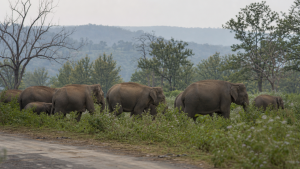
On August 17, 2026, a three-judge Supreme Court bench comprising Chief Justice Surya Kant, Justice Joymalya Bagchi, and Justice V. Mohana, hearing Prerna Singh Bindra & Ors. v. Union of India & Ors., directed the Ministry of Environment, Forest and Climate Change (MoEFCC) to conduct a fresh nationwide survey of elephant corridors. The Court ruled that no State or Union Territory can obstruct traditional pathways, and crop damage or local fear cannot justify blockades. The Centre must submit its status report on corridor obstructions and banned practices within six weeks. This directive has revived focus on habitat fragmentation, human-elephant conflict, and the legal obligations of corridor-sensitive conservation.
What elephant corridors are and why they matter
Elephant corridors are narrow, natural habitat linkages connecting larger forest patches, allowing elephants to migrate safely. Asian elephants (Elephas maximus), protected under Schedule I of India’s Wild Life (Protection) Act, 1972, and designated as India’s National Heritage Animal, are highly mobile, social, and act as a keystone species. Their movements are shaped by seasonal distributions of food, water, and dispersal needs. While a male elephant’s average home range spans 50 to 300 square kilometers, in fragmented landscapes, herds must often roam across thousands of square kilometers. Corridors act as ecological lifelines. They facilitate natural genetic exchange, prevent inbreeding, and allow safe access to seasonal resources. When corridors are blocked, elephants are forced into stressful detours, pushing them into agricultural fields and human settlements, which directly intensifies human-elephant conflict.
India’s elephant landscapes
India hosts approximately 60% of the global wild Asian elephant population. According to the DNA-based Synchronous All India Population Estimation of Elephants (SAIEE 2021–25), the country’s wild elephant population is estimated at 22,446, distributed across four principal landscapes: the Western Ghats (Southern Region, ~11,934 elephants), the North-Eastern Hills & Brahmaputra Floodplains (~6,559), the Shivalik Hills & Gangetic Plains (Northern Region, ~2,062), and Central India & Eastern Ghats (~1,891). Karnataka has the highest state population (6,013), followed by Assam (4,159), Tamil Nadu (3,136), Kerala (2,785), Uttarakhand (1,792), and Odisha (912). Under the MoEFCC’s Elephant Corridors of India 2023 report, the government ground-validated 150 corridors across 15 states, with West Bengal containing the highest number (26).
| Major Landscape | Ecological Character | Key Stress Points |
|---|---|---|
| Western Ghats | Largest stronghold; dense forests mixed with plantations | Resorts, roads, plantations, and linear infrastructure |
| Northeast | Dynamic riverine habitat with seasonal movement | Floodplain change, rail/road expansion, encroachment |
| Shivalik-Gangetic | Narrow forest belts and highly contested habitat | Urban growth, highways, tourism pressure |
| Central India | Forest patches separated by mining and cultivated land | Coal mining, industrial activity, fragmented routes |
What fragmentation does to elephant movement
Fragmentation occurs when continuous forests are divided into smaller, isolated patches by developmental projects. This turns connected habitats into isolated islands, forcing elephants to take longer, stressful detours. Reports show that 32% of corridors in southern India and 72.7% of northwestern corridors are compromised by agricultural expansion and human settlements. Blocked corridors restrict genetic flow, risking inbreeding and local extinction. When traditional pathways are obstructed, elephants venture into agricultural areas. Highly nutritious crops like paddy, sugarcane, and banana attract them strongly, transforming corridor blockage into a direct driver of recurring human-elephant conflict.
Main causes of corridor disruption
- Linear infrastructure: High-voltage power lines, canals, highways, and railway expansions (like the Bengaluru-Chennai line) split habitats and create severe electrocution and collision risks.
- Mining and quarrying: Open-cast coal mining and stone quarrying fragment forests, especially in Central India, driving herds into agricultural edges.
- Plantations and commercial land use: Large tea and coffee plantations replace natural diverse forage with monocultures, narrowing safe passages.
- Encroachment and fencing: Encroachment by farms, houses, boundary walls, and illegal electric fences blocks traditional migratory pathways.
- Urban and tourism pressure: Commercial resorts, tourist ashrams, and expanding towns near forest boundaries block critical movement bottlenecks.
Regional bottlenecks and stress points
In southern India, the Regional Action Plans for Human-Elephant Conflict in South India report (August 2026) mapped bottlenecks across 32 corridors, highlighting electric fences, resorts, ashrams, quarries, and the Bengaluru-Chennai railway line. In Tamil Nadu’s Segur Plateau Elephant Corridor, 38 commercial resorts were locked and sealed following Supreme Court orders. In the Shivalik-Gangetic plains, linear infrastructure and tourism around Haridwar and Rishikesh squeeze movement between Rajaji and Corbett National Parks. Central India faces heavy fragmentation from coal mining, pushing herds into stressful migrations, such as from Odisha to Chhattisgarh via the 20-km-long Charmar-Jingol corridor. Transboundary corridors are also under stress; the Mechi River corridor on the India-Nepal border faces physical barriers, showing that elephant movement ignores political boundaries.
Legal, constitutional and institutional angle
The Supreme Court’s August 2026 directives emphasize that traditional pathways cannot be blocked for administrative convenience or local fear. The Court ordered the MoEFCC to enforce a strict ban on barbaric and illegal coercive driving methods. This includes throwing fireballs, sharp spikes, burning mashaals (torches), and deploying “hulla parties” (local groups armed with iron rods, spikes, and fire tools) to drive elephants away. These coercive methods often inflict severe injuries, making herds aggressive and escalating conflict. The institutional challenge remains federal, requiring coordination between state forest departments, revenue authorities, infrastructure ministries, and local administrations to legalise and protect routes. Standardizing legal protections, such as declaring corridors as Eco-Sensitive Zones, is crucial to preventing commercial encroachment.
What a corridor-sensitive strategy should include
- Legal Corridor Protection: Formally notify ground-validated corridors as Eco-Sensitive Zones and strictly regulate land-use changes.
- Infrastructure Mitigation: Mandate wildlife underpasses, overpasses, eco-bridges, and speed restrictions on railway lines.
- Technology-driven Monitoring: Deploy early warning systems, including the ‘HaatiApp’, text alerts, sensor lights, and informational boards.
- Community-based Coexistence: Establish local response teams, ensure rapid crop compensation, and implement non-coercive conflict management.
- Prohibition of Coercive Methods: Enforce a strict ban on spikes, fire tools, and armed hulla parties, relying instead on trained forest staff.
Maintaining connectivity is central to elephant conservation and to reducing recurring conflict in India. Safeguarding corridors ensures elephants can access natural resources without entering human settlements, preserving both India’s National Heritage Animal and the communities living alongside them.
Practice Questions
-
Elephant corridors are increasingly being treated as ecological infrastructure. Discuss the role of these corridors in maintaining habitat connectivity, genetic diversity and conflict reduction. (Answer in 250 words)
-
Critically examine how linear infrastructure, land-use change and encroachment together intensify human-elephant conflict in India. Suggest measures to make development more wildlife-sensitive. (Answer in 250 words)
-
“Traditional wildlife pathways cannot be blocked by administrative convenience or local fear.” In the light of recent judicial intervention, evaluate the legal and governance challenges in protecting elephant corridors across states. (Answer in 250 words)
| Related | |
|---|---|