Hijab, Religious Freedom and Institutional Dress Codes
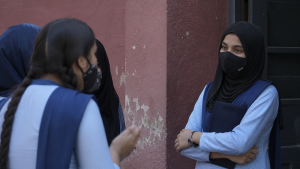
The Allahabad High Court’s dismissal of a student’s plea to wear a hijab with her uniform in Sukaina Rizvi v. State of U.P. (2026) has renewed the constitutional debate surrounding religious freedom, institutional discipline, and school dress codes.
What the dispute is really about
The dispute arose when a minor student at Tagore Public School in Prayagraj sought to wear a headscarf in addition to the prescribed school uniform. In Sukaina Rizvi v. State of U.P. (2026), the Allahabad High Court ruled that wearing a headscarf is not an essential religious practice in Islam, upholding the school’s uniform policy. This case sits at the intersection of individual religious rights under Article 25 and the administrative autonomy of educational institutions.
Religious freedom under Articles 25 to 28
Article 25 of the Constitution guarantees the freedom of conscience and the right to freely profess, practice, and propagate religion. However, this right is not absolute and remains subject to public order, morality, and health. In school settings, courts read Article 25 alongside principles of equality and non-discrimination, balancing a student’s desire for religious expression against an institution’s mandate to maintain a neutral learning environment.
How courts test religious claims
Indian courts apply the “essential religious practice” test to determine if a practice is protected under Article 25. To qualify, a practice must be an integral and essential part of the faith, without which the fundamental character of the religion would be altered. In the Sukaina Rizvi case, the court found that the petitioner failed to place authoritative religious texts or pleadings to prove that wearing a headscarf inside the classroom is obligatory in Islam, ruling that personal preferences do not enjoy automatic constitutional protection.
Precedents on uniforms and discipline
Judicial precedents consistently prioritize institutional dress codes over individual religious preferences in classrooms. In Resham v. State of Karnataka (2022), the Karnataka High Court ruled that wearing the hijab is not an essential religious practice and that dress codes foster a religion-neutral environment. While the Supreme Court delivered a split verdict in Aishat Shifa v. State of Karnataka (2022), the Resham ruling remains a highly persuasive authority. Additionally, in Fathima Thasneem v. State of Kerala (2018), the Kerala High Court held that the collective right of an institution to enforce a uniform overrides individual student preferences. Similarly, the Bombay High Court in Fathema Hussain Sayed v. Bharat Education Society (2002) upheld a standard uniform policy as compliant with Article 25.
Autonomy of private educational institutions
Private unaided educational institutions possess administrative autonomy to establish and enforce a uniform dress code, provided it is applied fairly and non-discriminatorily to all students. Tagore Public School, as a private CBSE-affiliated institution, was within its rights to enforce its uniform policy. The court also ruled that a school’s prior leniency or failure to object to a student wearing a headscarf in lower classes does not create a vested, legally enforceable right to continue doing so in higher classes.
Equality, minors and the classroom environment
School uniforms promote discipline, institutional identity, and equality by minimizing socioeconomic and religious distinctions among students. However, the rights of minors require a careful balance between family faith and the school’s duty to cultivate a shared civic space. The core policy challenge is whether classrooms should allow diverse religious markers within a uniform framework or require individual expression to yield to a common standard to foster social cohesion.
Way forward for institutions and courts
Schools should clearly specify uniform policies and any permissible accommodations during admission to ensure predictability. Courts must apply the essential religious practice test with precision, protecting genuine religious rights without undermining institutional discipline. A balanced approach combines neutrality with reasonable accommodation, allowing flexibility where safety or uniformity is unaffected, while upholding a common dress code to maintain a religion-neutral classroom.
Practice Questions
- Religious freedom under Article 25 is subject to institutional discipline in educational spaces. Discuss critically the constitutional balance between individual faith and school uniform rules. (Answer in 250 words)
- The essential religious practice test remains central to adjudicating conflicts between faith and public policy. Critically examine its strengths and limitations in cases involving student dress codes. (Answer in 250 words)
- Uniforms are often defended as instruments of equality and social cohesion, yet they can also raise concerns of religious exclusion. Evaluate the role of private schools in managing such conflicts and suggest measures for a fair approach. (Answer in 150 words)
| Related | |
|---|---|