Pakistan’s Defence Reforms and Nuclear Command Structure
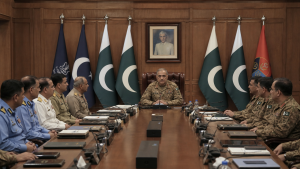
Pakistan’s enactment of the Defence Forces of Pakistan Act, 2026, and amendments to the National Command Authority Act, 2010, on August 20, 2026, signal a major overhaul of its defence and nuclear command structure, with wider implications for civil-military balance and strategic decision-making.
Background: Pakistan’s defence and strategic command set-up
Historically, Pakistan’s higher military coordination was structured around the Chairman Joint Chiefs of Staff Committee (CJCSC). The CJCSC was primarily an advisory post lacking operational control. In practice, the Chief of Army Staff (COAS) wielded supreme power, leaving inter-service coordination to an informal hierarchy. To address this, Pakistan passed the 27th Constitutional Amendment in November 2025, amending Article 243 to abolish the CJCSC and establish the statutory office of Chief of Defence Forces (CDF). Field Marshal Asim Munir concurrently assumed office as the first CDF on December 4, 2025. It also created the four-star Commander of the National Strategic Command (CNSC) position, filled by General Syed Aamer Raza in July 2026.
What does the Defence Forces of Pakistan Act, 2026 change?
The Defence Forces of Pakistan Act, 2026, operationalizes the CDF’s constitutional mandate. Approved by the cabinet and introduced by Defence Minister Khawaja Asif, it passed on August 20, 2026, despite strong opposition and a PTI walkout. The Act integrates all services under a unified command at the Defence Forces Headquarters (DFHQ) in Chaklala, Rawalpindi, under the CDF. It designates the CDF as the Prime Minister’s principal military advisor on national security and tri-services. Crucially, the Act grants the CDF sweeping administrative powers over military personnel—including hiring, firing, retiring, or altering retirement age limits (excluding those directly appointed under Article 243). This effectively centralizes absolute operational command under Field Marshal Asim Munir.
How has the National Command Authority law been changed?
The National Command Authority (Amendment) Act, 2026, implemented retrospectively from November 27, 2025, replaces references to the CJCSC with the COAS and the CDF, aligning nuclear command with the new military hierarchy. This amendment integrates the newly established role of the CNSC, currently held by General Syed Aamer Raza. The CNSC serves a three-year term, with provision for a potential three-year extension on the CDF’s recommendation. Crucially, the law insulates the CNSC’s appointment, tenure, and extension from judicial challenge, stating that they cannot be called into question before any court of law on any ground. This grants the strategic command system complete legal autonomy.
How does the National Command Authority fit into nuclear command and control?
The NCA is Pakistan’s apex body for nuclear policy, operational control, and employment. It functions through a highly structured command system:
| Body / Institution | Main Strategic Role |
|---|---|
| Employment Control Committee | Decides on nuclear employment, deployment, targeting guidelines, and strategic policy direction. |
| Development Control Committee | Oversees the technical development, production, and categorization of strategic assets and delivery systems. |
| Strategic Plans Division (SPD) | Provides administrative and secretariat support, managing operational security, safety, and physical command arrangements. |
| National Strategic Command (NSC) | Acts as the unified operational headquarters, integrating the strategic capabilities of the Army, Navy, and Air Force under the CNSC. |
While the Prime Minister formally chairs the NCA, the military retains de facto operational command. The 2026 amendments make this explicit by placing conventional and strategic command under a single military leadership structure.
What are the institutional implications?
The concentration of authority under Field Marshal Asim Munir (concurrently serving as COAS and CDF) represents a decisive tilt in Pakistan’s civil-military balance. Rather than relying on informal influence, military supremacy is now legally codified, reducing the scope for civilian cabinet-level scrutiny. Furthermore, the Navy and Air Force lose significant autonomy. With the CDF issuing binding directives and controlling personnel, separate service doctrines are subordinated to an Army-dominated command. While this improves joint operational efficiency, it limits internal checks and balances, focusing nuclear and conventional control within a singular, insulated military office.
This structural shift goes beyond simple administrative efficiency. It establishes a legally insulated military leadership that controls both the conventional war-fighting machinery and the strategic nuclear deterrent, effectively placing military decision-making beyond civilian parliamentary accountability.
What does this mean for civil-military relations in Pakistan?
The civil-military balance has shifted toward structural asymmetry. The military chief now has a statutory mandate to determine national defense policy, minimizing cabinet oversight. This institutionalization of military power was achieved through legislative amendments rather than direct intervention, entrenching military authority deeply within the legal system and leaving civilian leaders with limited recourse to contest strategic decisions.
Why does this matter for India and South Asia?
For India, the centralization of Pakistan’s military apparatus carries deep strategic implications during crises. A unified conventional, rocket (such as the Army Rocket Force Command established in 2025), and strategic command allows Pakistan to make multi-domain operational decisions at a much faster pace. This integrated posture could challenge India’s Dynamic Response Strategy and escalation control mechanisms. Additionally, the compressed decision-making window increases the risk of rapid, unintended escalation. Crisis communication also becomes more complex. With decision-making concentrated in a smaller military circle, strategic signaling becomes direct but highly opaque, limiting room for diplomatic intervention.
Challenges and concerns
- Erosion of Democratic Oversight: Codified military supremacy weakens parliament’s role in defense policy and strategic appointments.
- Deterrence Instability: Integrating conventional forces and strategic assets under a single operational command risks early escalation.
- Reduced Transparency: The judicial insulation of the CNSC limits external visibility into strategic safety protocols.
- Inter-Service Friction: Army dominance through the CDF post could undermine long-term cohesion among other military branches.
Way forward
- Democratic Balances: Pakistan must build transparent oversight mechanisms to reconcile military jointness with constitutional accountability.
- Strengthening Communication: Reliable military-to-military crisis communication channels between India and Pakistan are essential to mitigate miscalculations.
- Indian Strategic Adaptability: India should accelerate its own tri-service integration and enhance its intelligence, surveillance, and reconnaissance (ISR) capabilities.
- Risk Reduction: Both nations would benefit from bilateral dialogue focusing on strategic risk reduction and missile notifications.
Practice Questions
- Pakistan’s recent defence reforms have formalised a highly centralised command structure. Discuss their implications for civil-military relations and democratic accountability. (Answer in 150 words)
- Critically examine how changes in Pakistan’s nuclear command architecture can affect deterrence stability in South Asia and India’s crisis management options. (Answer in 250 words)
- Compare Pakistan’s Chief of Defence Forces model with India’s approach to joint military integration. What do these differences reveal about civilian control and strategic decision-making? (Answer in 250 words)
| Related | |
|---|---|