
Tamil Nadu Launches Third Phase of Poompuhar Underwater Exploration
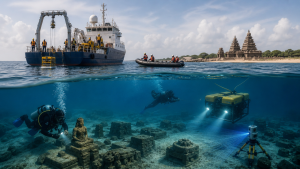
The Tamil Nadu State Department of Archaeology (TNSDA) launched the third phase of underwater archaeological exploration off Poompuhar, also known as Kaveripoompattinam, in Mayiladuthurai district on 6 September 2026. The project is being carried out with the Indian Maritime University and covers an underwater zone linked to the ancient Sangam-era port city.
Underwater archaeology in India
Underwater archaeology studies submerged cultural remains such as ports, shipwrecks, anchors, pottery, and harbour structures. In India, such work is carried out in coastal and offshore zones where sea-level change, erosion, and sedimentation have covered ancient settlements.
Poompuhar and Sangam-era port history
Poompuhar is identified with Kaveripoompattinam, a historic port city associated with the Sangam age in Tamil literary tradition. The site lies on the Coromandel Coast and is linked with maritime trade in the early historic period.
The present survey targets an underwater area of about 250 square kilometres, located nearly 2 kilometres offshore, at depths ranging from 2 metres to 60 metres. The operation is scheduled as a 20-day deep-sea exercise ending on 23 September 2026.
Survey methods and field team
The exploration uses side-scan sonar, echosounders, and sub-bottom profilers to detect seabed anomalies and buried structures. These instruments are standard marine survey tools used to map the sea floor and identify features beneath sediment layers.
A 25-member team has been deployed for the phase, including up to 10 professional divers and archaeologists-cum-divers. The field work is being guided by marine research consultant Prof. K. Rajan and TNSDA Joint Director Dr. Yatish Kumar.
Important Facts for Exams
- Poompuhar is also known as Kaveripoompattinam and is associated with the Sangam age.
- Side-scan sonar is used to create images of the sea floor by sending acoustic pulses sideways.
- Sub-bottom profilers are used to detect layers and objects below the seabed surface.
- Underwater archaeological surveys in India often focus on ancient ports, shipwrecks, and submerged habitations.
Project timeline and funding
Preliminary studies for the multi-phase initiative began in February 2025, followed by the first phase in September 2025 and the second phase of diving in March 2026. The Union Ministry of Culture stated in a written reply to the Rajya Sabha that TNSDA has earmarked ₹7 crore for land and underwater archaeological excavations.
| Related | |
|---|---|



Dr.Cajetan Coelho
September 7, 2026 at 2:07 pmKaveripoompattinam, in Mayiladuthurai district is a rich historical site. Wishing the team of divers, archaeologists-cum-divers, marine research consultant Prof. K. Rajan and TNSDA Joint Director Dr. Yatish Kumar much success in their research endeavors.