State-Wise Human Development Trends in India
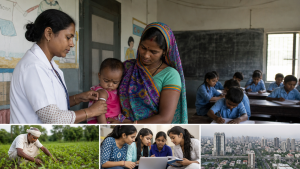
Human development measures how effectively a population can achieve a long and healthy life, access knowledge, and secure a decent standard of living. In India, the national picture often hides sharp differences between states and union territories.
Sub-national Human Development Index trends are important for understanding regional inequalities, identifying lagging areas, and designing better-targeted welfare and growth policies.
Core Dimensions and Measurement
- Health dimension: Measured by life expectancy at birth, which reflects longevity, nutrition, public health infrastructure, and disease control.
- Education dimension: Measured through mean years of schooling for adults aged 25 years and older and expected years of schooling for children entering school age.
- Standard of living dimension: Measured by Gross National Income (GNI) per capita adjusted for purchasing power parity (PPP); at the state level, proxies such as per capita net state domestic product and consumer expenditure are used.
- Inequality-Adjusted Human Development Index (IHDI): Penalizes overall performance when internal disparities are high.
- Gender Development Index (GDI): Captures male-female gaps in human development outcomes.
Regional Trends Across States and Union Territories
Indian states show a clear spread in human development performance, with long-standing differences across regions.
- Kerala: Consistently ranks at the top among major states due to high literacy, strong public healthcare, low infant mortality, and active social welfare transfers.
- Goa and Himachal Pradesh: Perform strongly because of higher per capita incomes, rural infrastructure development, and better school enrolment.
- Delhi, Chandigarh and Puducherry: Record high HDI scores due to urban concentration, better civic amenities, and easier access to institutions.
- Bihar and Jharkhand: Remain at the lower end, affected by low mean years of schooling, multi-dimensional poverty, and weak per capita incomes.
- Uttar Pradesh and Madhya Pradesh: Have lower composite scores despite economic growth, mainly because of large rural populations, health access gaps, and poor learning outcomes.
Key Determinants of State-Level Variation
- Public expenditure on the social sector: States spending more on health, primary education, and sanitation generally show faster gains in life expectancy and literacy.
- Institutional capacity: Effective local governance, decentralized panchayati raj institutions, and transparent welfare delivery reduce leakages and improve outcomes.
- Per capita income and growth quality: Higher Gross State Domestic Product (GSDP) helps resource mobilisation, but inclusive growth and formal employment are needed to convert wealth into development.
- Gender empowerment: Higher female literacy, lower maternal mortality, and active women self-help group networks are linked to better social development.
- Rural-urban divide: Better infrastructure and institutional access in urban areas often raise human development outcomes faster than in remote rural regions.
Policy Implications for Inclusive Growth
- Aspirational Districts Programme: Focused administrative and financial support can help backward districts address deficits in health, nutrition, and basic infrastructure.
- Foundational learning: Strong primary schooling, lower dropout rates, and skill-based education are essential for long-term workforce productivity.
- Primary healthcare reinforcement: Expanding Ayushman Arogya Mandirs and strengthening primary health centres improves preventive care access in rural areas.
- Fiscal federalism: Need-based devolution through the Finance Commission can help fiscally weaker states expand social sector spending without excessive debt.
- Women-centred development: Higher female education and better maternal health outcomes improve household welfare and broader human development indicators.
Essential Facts and Official Terms
- HDI origin: The Human Development Index methodology was pioneered by Mahbub ul Haq and Amartya Sen for the United Nations Development Programme in 1990.
- Kerala: Traditionally records the highest literacy rate and female life expectancy among Indian states.
- Health spending: Public health spending as a share of state budgets varies widely and is linked to out-of-pocket health expenditure burdens in low-HDI states.
- National Multidimensional Poverty Index: Released by NITI Aayog, it complements HDI by tracking deprivations in health, education, and standard of living at the district level.
Exam focus: HDI is a composite measure of health, education, and standard of living. At the state level, Kerala, Goa, Himachal Pradesh, Delhi, Chandigarh and Puducherry tend to perform better, while Bihar, Jharkhand, Uttar Pradesh and Madhya Pradesh lag behind.
Key Prelims Takeaways
- HDI measures three dimensions: health, education, and standard of living.
- Life expectancy at birth is the key health indicator in HDI.
- Mean years of schooling and expected years of schooling are the two education indicators.
- GNI per capita (PPP) is the standard of living indicator in global HDI calculations.
- IHDI adjusts HDI for internal inequality.
- GDI highlights gender gaps in human development.
- NITI Aayog’s MPI is useful for understanding district-level deprivation alongside HDI.
| Related | |
|---|---|