India–Nepal Relations: Key Events, Treaties and Bilateral Mechanisms
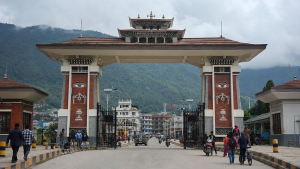
India and Nepal share one of South Asia’s closest bilateral relationships, shaped by open borders, centuries-old social ties, and a dense network of treaties and agreements. For Prelims revision, the relationship is important for its boundary framework, hydropower cooperation, trade connectivity, and institutional mechanisms.
Foundational Treaties and Boundary Framework
- 1950 Treaty of Peace and Friendship: It is the bedrock of India–Nepal relations and provides for an open-border system, allowing citizens of both countries to travel, reside and work across the border without passports or visas.
- Reciprocal treatment: Articles 6 and 7 of the 1950 Treaty provide reciprocal treatment to each other’s citizens in matters such as property ownership, trade and economic movement.
- Treaty of Sugauli, 1816: Signed between the Kingdom of Nepal and the British East India Company, it is the main historical reference for Nepal’s western boundary.
- Kalapani dispute: The undefined source of the Kali (Mahakali) River has led to differences over Kalapani, Lipulekh and Limpiyadhura, as the two sides interpret the river’s origin differently.
- Border length: The India–Nepal boundary stretches over about 1,850 km.
- Indian states bordering Nepal: Uttarakhand, Uttar Pradesh, Bihar, West Bengal and Sikkim.
- Border management: On the Indian side, the border is guarded by the Sashastra Seema Bal (SSB), a Central Armed Police Force under the Ministry of Home Affairs.
Hydropower and Energy Cooperation
- Electricity trade: India and Nepal signed a 25-year bilateral agreement in January 2024 to facilitate export of 10,000 MW of electricity from Nepal to India over 10 years.
- Bangladesh power supply: Under a trilateral arrangement in 2024, Nepal began exporting 40 MW of electricity to Bangladesh using the Indian power grid.
- Cross-border transmission: POWERGRID and the Nepal Electricity Authority signed joint venture and shareholder agreements in October 2025 for two 400 kV transmission lines: Inaruwa–New Purnea and Lamki–Bareilly.
- Completion target: These transmission lines are targeted for completion by 2030.
- Mahakali Treaty, 1996: It governs integrated development of the Mahakali River and includes the proposed Pancheshwar Multipurpose Project for energy and irrigation.
Trade, Connectivity and Financial Linkages
- Trade and transit: India is Nepal’s largest trade partner and provides transit access for Nepal’s third-country maritime trade through ports such as Kolkata, Haldia and Visakhapatnam.
- Integrated Check Posts: Raxaul-Birgunj and Jogbani-Biratnagar are major ICPs and handle a large share of bilateral containerised cargo.
- Rail connectivity: The Jayanagar-Kurtha link is the first broad-gauge passenger railway service between India and Nepal.
- Digital payments: The UPI-NPI Peer-to-Peer linkage connects India’s Unified Payments Interface with Nepal’s National Payments Interface to simplify cross-border remittances.
- Legal cooperation: India and Nepal completed internal administrative processes in June 2026 to implement the Mutual Legal Assistance Agreement (MLAA) in criminal matters.
Major Bilateral Mechanisms and Agreements
| Treaty or Mechanism | Key Objective or Boundary Defined | Year |
| Treaty of Sugauli | Marked Nepal’s western boundary along the Mahakali River | 1816 |
| Treaty of Peace and Friendship | Established open borders and reciprocal civic treatment | 1950 |
| Mahakali Treaty | Governs joint water and energy projects on the Mahakali River | 1996 |
| Mutual Legal Assistance Agreement | Legal framework to investigate cross-border crimes | 2026 |
Key Prelims Takeaways
- Open border: The 1950 Treaty permits movement without passports or visas.
- Boundary reference: The 1816 Treaty of Sugauli is central to the western boundary issue.
- Border states: Nepal shares its border with five Indian states—Uttarakhand, Uttar Pradesh, Bihar, West Bengal and Sikkim.
- Border force: The SSB is the designated Indian border guarding force along Nepal.
- Military exercise: Surya Kiran is the annual India-Nepal joint military exercise.
- Energy link: Nepal’s electricity export to Bangladesh through Indian transmission lines is a notable trilateral development.
- Trade route: Indian ports and ICPs are essential for Nepal’s external trade and transit.
Exam tip: For map-based questions, remember that the India–Nepal border touches Uttarakhand, Uttar Pradesh, Bihar, West Bengal and Sikkim.
Current General Studies comprises current-affairs-based, General Studies-rich study material on policies, laws, institutions, economy, science, environment, governance, international relations, and other varied but important topics for UPSC and State PSC Prelims examinations.
Fortnightly PDF compilations: Available here
Originally written on
February 15, 2026
and last modified on
September 4, 2026.
| Related | |
|---|---|