
Sandhara, Nirandhara and Sarvatobhadra Temples
The structural evolution of Hindu temple architecture, particularly during the Gupta and Chalukyan periods, introduced specific layouts based on the provision for Pradakshina Patha (circumambulatory path). These classifications—Sandhara, Nirandhara, and Sarvatobhadra—describe how a devotee interacts with the deity and the temple space.
Sandhara Temples: The Enclosed Path
A Sandhara temple is characterized by a circumambulatory path that is enclosed between the inner sanctum (Garbhagriha) and the outer walls of the temple. Devotees perform Pradakshina inside the structure, often in a dimly lit corridor.
- Structural Layout: The temple consists of a double wall. The inner wall forms the Garbhagriha, and the outer wall creates the exterior shell.
- Lighting and Ventilation: Since the path is internal, these temples often feature Jalis (latticed stone windows) to allow light and air into the corridor.
- Examples in India:
- Lad Khan Temple, Aihole: An early example where the path is integrated into the hall.
- Kandariya Mahadeva, Khajuraho: Represents the pinnacle of the Sandhara style with a highly decorated internal passage.
- Lakshmana Temple, Khajuraho: Features an elaborate internal walkway with sculptural friezes.
Nirandhara Temples: The External Path
Nirandhara temples are built without an internal circumambulatory path. In these structures, the Garbhagriha stands directly against or as part of the outer walls. If a devotee wishes to perform Pradakshina, they must do so outside the temple on the raised platform (Jagati).
- Structural Layout: This is a simpler, single-walled construction. The exterior of the sanctum is directly exposed to the outside.
- Aesthetic Impact: These temples often emphasize the external carvings of the Vimana or Shikhara since the devotee views the deity’s “house” from the outside.
- Examples in India:
- Teli ka Mandir, Gwalior: A unique blend of styles that lacks an internal passage.
- Early Gupta Temples: Many early shrines, like Temple No. 17 at Sanchi, follow this basic plan.
Sarvatobhadra Temples: The Multi-Entry Shrine
Sarvatobhadra translates to “good from all sides.” These temples are designed to be accessible or visible from all four cardinal directions. They are typically square and feature four functional entrances.
- Structural Layout: The Garbhagriha is placed at the center of the structure with openings on the North, South, East, and West. This design is often associated with high-status imperial temples.
- Symbolism: It represents the omnipresence of the deity, radiating power in every direction.
- Technical Requirements: These temples usually require a large Mandapa or a complex series of porches to support the four-way entry.
- Examples in India:
- Dashavatara Temple, Deogarh: A classic Gupta period example. Though it has one main entrance, it features three large carved niches on the other sides, mimicking the Sarvatobhadra philosophy.
- Chaturmukha Temples: Many Jain temples, such as the Ranakpur Jain Temple, follow the Sarvatobhadra plan to house the four-faced Tirthankara images.
Comparative Summary of Temple Types
| Feature | Sandhara | Nirandhara | Sarvatobhadra |
| Pradakshina Path | Internal (Enclosed) | External (Open) | Multi-directional/Internal |
| Wall Structure | Double Wall | Single Wall | Multi-entry / Centralized |
| Light Source | Pierced stone windows (Jalis) | Direct natural light | Openings on four sides |
| Complexity | High | Low | Very High |
| Primary Example | Kandariya Mahadeva | Sanchi Temple 17 | Deogarh Dashavatara |
Technical Terms in Temple Architecture
- Jagati: The raised platform on which the temple is built, often used for circumambulation in Nirandhara temples.
- Antarala: The vestibule or space between the Garbhagriha and the Mandapa.
- Pradakshina Patha: The walkway meant for walking around the idol in a clockwise direction.
- Vimana/Shikhara: The mountain-like spire over the sanctum.
Historical Context for UPSC Prelims
The transition from Nirandhara to Sandhara reflects the growing complexity of Hindu rituals during the mid-to-late 1st millennium CE. Early temples were small and functional (Nirandhara). As the Bhakti movement grew, temples became “palaces” for deities, requiring larger spaces for congregational worship and elaborate internal rituals (Sandhara). The Sarvatobhadra style remained rarer, reserved for major pilgrimage centers or royal commissions due to its complex engineering requirements.
Architectural Trivia
- The Vishnu Temple at Deogarh is one of the earliest to move toward the Sarvatobhadra concept by placing elaborate carvings of Vishnu (Gajendra Moksha, Nara-Narayana, and Anantashayi Vishnu) on the three exterior walls.
- In Dravidian Architecture, the Sandhara style is often achieved through large Prakaras (concentric enclosures) rather than just a narrow corridor around the sanctum.
- The Pancha Rathas at Mahabalipuram provide a live “catalog” of these styles carved out of monolithic rocks, showing different experiments with paths and entries.

Atul Singh
June 11, 2015 at 6:30 pmPlease correct this article. As per several resources Sandhara Temple is a temple WITH Pradakshinapatha. While as Nirandhara is a temple WITHOUT Pradakshinapatha.
GKToday
June 11, 2015 at 6:43 pmHello, Thank you for pointing this out. The article has been updated.
Howard Roark
June 30, 2016 at 9:00 pmClass 11th Indian Art NCERT page 32 states Sandhara without Pradikhshinapath and Nirandhara with Pradikhshinapath. Is that wrong?
GKToday
July 1, 2016 at 9:59 amHello, If you are talking about below screenshot, the information in NCERT book is an error.
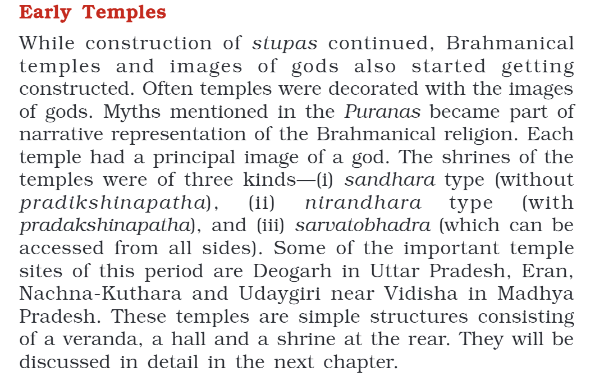
Garbhagraha with Pradakshinapatha is Sandhara while that without it is Nirandhara. Kindly refer to other sources or search in Google Books.
Howard Roark
July 11, 2016 at 9:35 pmSir, thanks a lot. Keep guiding.
Rohit
May 26, 2020 at 11:07 amThanks so much sir…for this imp. Information