Major Protected Areas and Wildlife Sanctuaries of Assam
Assam’s Protected Areas: An Overview
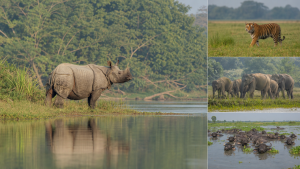
Assam lies at the junction of the Indo-Malayan and Palearctic biogeographic realms, making it one of India’s richest biodiversity regions. The Brahmaputra and Barak river systems support a dense network of national parks, wildlife sanctuaries, tiger reserves, elephant reserves and a Ramsar wetland.
These protected areas are crucial for species such as the Indian one-horned rhinoceros, Royal Bengal tiger, Asian elephant, wild water buffalo, golden langur and Bengal florican.
Classification and Legal Status
- National Parks: Category II protected areas under the Wild Life (Protection) Act, 1972. Human activities such as forestry, grazing and private land ownership are strictly prohibited.
- Wildlife Sanctuaries: Category IV protected areas focused on species protection, while allowing limited traditional rights such as regulated timber harvesting or cattle grazing.
- Tiger Reserves: Conservation areas under Project Tiger and supervised by the National Tiger Conservation Authority for protection of core tiger habitats.
- Elephant Reserves: Administrative conservation landscapes under Project Elephant to maintain habitat continuity and traditional migration corridors.
- Ramsar Sites: Wetlands designated under the Ramsar Convention for wise ecological use and international hydrological importance.
Assam has 7 National Parks, 17 Wildlife Sanctuaries, 4 Tiger Reserves, 5 Elephant Reserves and 1 Ramsar Site.
Major National Parks of Assam
- Kaziranga National Park: Spread across Golaghat, Nagaon, Sonitpur and Biswanath districts along the Brahmaputra. It was declared a UNESCO World Heritage Site in 1985 and a Tiger Reserve in 2006. It is home to two-thirds of the world’s Indian one-horned rhinoceroses, along with tigers, Asian elephants, wild water buffaloes and swamp deer.
- Manas National Park: Located in the Bhabar tract across Baksa and Chirang districts near the Eastern Himalayas. It was declared a UNESCO World Heritage Site in 1985, a Project Tiger Reserve in 1973 and a Biosphere Reserve in 1989. It is contiguous with Bhutan’s Royal Manas National Park.
- Orang National Park: Situated on the northern bank of the Brahmaputra in Darrang and Sonitpur districts. It was declared a Tiger Reserve in 2016 and is often called the “Mini Kaziranga” because of its riverine grassland landscape and high rhino density.
- Nameri National Park: Located in Sonitpur district at the Himalayan foothills. Its northern boundary meets Pakhui (Pakke) Tiger Reserve in Arunachal Pradesh, and it is bisected by the Jia Bhoroli river. It is a major refuge for the white-winged wood duck and golden mahseer.
- Dibru-Saikhowa National Park: Situated in Dibrugarh and Tinsukia districts, bounded by the Brahmaputra, Lohit and Dibru rivers. It forms a Biosphere Reserve and contains the largest Salix swamp forest in northeastern India. It is also known for feral horses.
- Raimona National Park: Notified in June 2021 in Kokrajhar district within the Bodoland Territorial Region. It lies within the Chirang-Ripu Elephant Reserve and serves as an important ecological corridor connecting Phibsoo Wildlife Sanctuary in Bhutan.
- Dehing Patkai National Park: Notified in June 2021 across Dibrugarh and Tinsukia districts. It is known as the “Amazon of the East” for its dense tropical lowland rainforest and rich primate diversity.
Important Wildlife Sanctuaries
- Pobitora Wildlife Sanctuary: Located in Morigaon district near Guwahati. It has the highest population density of the Indian one-horned rhinoceros in the world within its small grassland core.
- Hollongapar Gibbon Wildlife Sanctuary: Located in Jorhat district. It is the only habitat in India for the western hoolock gibbon, the country’s only non-human ape, and also supports six other primate species.
- Chakrashila Wildlife Sanctuary: Situated in Dhubri and Kokrajhar districts. It is India’s first sanctuary focused specifically on the conservation of the endangered golden langur and includes the Diplai Beel and Dheer Beel wetlands.
- Bornadi Wildlife Sanctuary: Located in Udalguri and Baksa districts along the Bhutan border. It was established primarily to protect the critically endangered pygmy hog and hispid hare.
- Deepor Beel Wildlife Sanctuary: Located on the southwestern edge of Guwahati in Kamrup Metropolitan district. It is Assam’s only Ramsar site and a major staging ground for migratory waterbirds.
- Burachapori and Laokhowa Sanctuaries: Situated along the southern bank of the Brahmaputra in Sonitpur and Nagaon districts. Together they form a vital eco-corridor for wildlife movement between Kaziranga and Orang National Parks.
Why Assam Matters in Conservation
- Rhino stronghold: Assam holds over 70 percent of the world’s remaining population of the Indian one-horned rhinoceros.
- UNESCO sites: Kaziranga National Park and Manas National Park are Assam’s two UNESCO Natural World Heritage Sites, both inscribed in 1985.
- Tiger reserves: The state has four designated Tiger Reserves — Manas, Nameri, Kaziranga and Orang.
- White-winged wood duck: Assam’s state bird depends heavily on the primary forest canopy of Nameri and Dibru-Saikhowa National Parks.
- Primate diversity: Hollongapar Gibbon Wildlife Sanctuary is especially significant because it protects India’s only ape species, the western hoolock gibbon.
- Wetland importance: Deepor Beel is vital for migratory waterbirds and aquatic fauna, making it the state’s lone Ramsar wetland.
Protected Areas at a Glance
| Protected Area | District / Region | Primary Conservation Focus | Official Status |
| Kaziranga | Golaghat, Nagaon, Sonitpur, Biswanath | One-horned rhino, tiger, wild buffalo | UNESCO World Heritage Site, Tiger Reserve |
| Manas | Baksa, Chirang | Pygmy hog, golden langur, hispid hare | UNESCO World Heritage Site, Tiger Reserve, Biosphere Reserve |
| Orang | Darrang, Sonitpur | One-horned rhino, Royal Bengal tiger | National Park, Tiger Reserve |
| Nameri | Sonitpur | White-winged wood duck, golden mahseer | National Park, Tiger Reserve |
| Dibru-Saikhowa | Dibrugarh, Tinsukia | Feral horses, Salix swamp forest | National Park, Biosphere Reserve |
| Raimona | Kokrajhar | Golden langur, Asian elephant | National Park, Elephant Reserve zone |
| Dehing Patkai | Dibrugarh, Tinsukia | Hoolock gibbon, lowland rainforest | National Park, Elephant Reserve zone |
| Pobitora | Morigaon | Highest density of one-horned rhinoceros | Wildlife Sanctuary |
| Hollongapar Gibbon | Jorhat | Western hoolock gibbon, primates | Wildlife Sanctuary |
| Deepor Beel | Kamrup Metropolitan | Migratory birds, aquatic fauna | Wildlife Sanctuary, Ramsar Site |
Key Prelims Takeaways
- Assam’s protected network: 7 National Parks, 17 Wildlife Sanctuaries, 4 Tiger Reserves, 5 Elephant Reserves and 1 Ramsar Site.
- Kaziranga and Manas: The two UNESCO Natural World Heritage Sites in Assam, both inscribed in 1985.
- Largest rhino population: Kaziranga is the core stronghold, while Pobitora has the highest rhino density.
- Only ape species: Hollongapar Gibbon protects the western hoolock gibbon, India’s only non-human ape.
- Golden langur: Chakrashila is the first sanctuary dedicated specifically to this endangered species.
- Ramsar wetland: Deepor Beel is Assam’s only Ramsar site and a key migratory bird habitat.
- 2021 additions: Raimona and Dehing Patkai were notified as national parks in June 2021.
Current General Studies comprises current-affairs-based, General Studies-rich study material on policies, laws, institutions, economy, science, environment, governance, international relations, and other varied but important topics for UPSC and State PSC Prelims examinations.
Fortnightly PDF compilations: Available here
Originally written on
May 25, 2026
and last modified on
September 6, 2026.
| Related | |
|---|---|