NEP 2020: Arts and Holistic Education
The National Education Policy (NEP) 2020 shifts Indian schooling away from rote learning and rigid subject silos toward experiential, arts-integrated and holistic education. It links cognitive growth with social, ethical and emotional development across stages of learning.
Approved by the Union Cabinet on July 29, 2020, NEP 2020 replaced the 34-year-old National Policy on Education, 1986. Its school curriculum reforms are meant to make learning flexible, multidisciplinary and more rooted in Indian knowledge systems and local culture.
5+3+3+4 Curricular Framework
- Foundational stage (ages 3-8): Covers 3 years of Anganwadi or preschool education plus Classes 1 and 2.
- Foundational pedagogy: Focuses on play-based, activity-based and discovery-oriented learning.
- Preparatory stage (ages 8-11): Includes Classes 3 to 5 and gradually introduces light textbook learning.
- Preparatory pedagogy: Emphasises interactive classroom instruction and basic reading, writing and mathematics.
- Middle stage (ages 11-14): Covers Classes 6 to 8 and introduces subject-specific learning in sciences, mathematics, arts, social sciences and humanities.
- Secondary stage (ages 14-18): Spans Classes 9 to 12 in two phases, Classes 9-10 and Classes 11-12.
- Flexible subject choices: Allows multidisciplinary combinations without rigid separation among arts, sciences and commerce.
Breaking Rigid Subject Boundaries
- No hard separation: Removes strict divisions between academic streams, extracurricular activities and vocational education.
- Equal status for arts: Gives visual arts, performing arts, sports and vocational crafts parity with core subjects such as mathematics and science.
- Multidisciplinary learning: Encourages students to choose subjects across disciplines based on interest and aptitude.
- Holistic development: Aims to build knowledge, creativity, physical ability and practical competence together.
Art-Integrated and Sports-Integrated Pedagogy
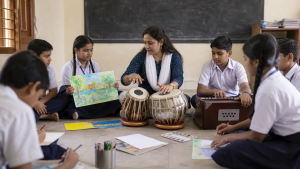
- Art-integrated learning: Uses Indian art forms, crafts, music, dance and theatre to teach core subjects.
- Cross-curricular linkage: Connects artistic expression with subjects such as mathematics, science and social studies.
- Joyful learning: Uses visual and performing arts to explain abstract concepts in a more engaging way.
- Illustrative classroom use: Traditional rangoli patterns can be used for geometry, while folk theatre can support history learning.
- Cultural rootedness: Links classroom concepts with local, regional and national artistic traditions.
- Sports-integrated pedagogy: Includes physical activities, indigenous games and sports in daily learning routines.
- Broader benefits: Promotes fitness, team spirit, mental well-being and discipline.
- Cognitive use of movement: Games and physical activities can help teach spatial orientation, mathematical calculations and scientific principles.
Experiential Learning and Vocational Exposure
- Hands-on learning: Replaces mechanical memorisation with activities, field trips, experiments, storytelling and projects.
- Inquiry-driven approach: Encourages students to ask questions, explore and apply concepts rather than only memorising facts.
- Competency-based education: Focuses on learning outcomes and practical skills instead of only syllabus completion.
- 10 bagless days: For Classes 6 to 8, the policy provides a 10-day bagless period for vocational and experiential exposure.
- Local skill learning: Students may learn from potters, carpenters, gardeners, weavers and artists.
- Stress-free exposure: Formal guidelines for bagless days aim to make skill learning joyful and structured.
Assessment Reforms and Indian Knowledge Systems
- 360-degree progress card: Replaces marks-only report cards with a broader assessment of cognitive, affective and psychomotor domains.
- Multiple feedback sources: Includes self-assessment, peer review, teacher evaluation, project portfolios and practical tasks.
- PARAKH: The Performance Assessment, Review, and Analysis of Knowledge for Holistic Development is the national assessment centre.
- Institutional role: PARAKH functions under NCERT and is meant to set uniform evaluation standards.
- Indian Knowledge Systems: The policy integrates lok vidya, traditional crafts and vocational knowledge into curricula.
- Local and indigenous knowledge: Includes tribal lore, indigenous medical traditions, sustainable agriculture and traditional architecture.
- Mother tongue emphasis: Recommends the mother tongue, local language or regional language as medium of instruction up to Class 5, and preferably up to Class 8.
Key Prelims Takeaways
- NEP approval: The Union Cabinet approved NEP 2020 on July 29, 2020.
- Policy replacement: It replaced the National Policy on Education, 1986.
- Curricular reform: The 10+2 structure was replaced by the 5+3+3+4 framework.
- Age coverage: The new framework covers ages 3 to 18, bringing early childhood care into formal schooling.
- Arts emphasis: Visual arts, music, dance, theatre and crafts are central pedagogical tools, not add-ons.
- Bagless days: The 10 bagless days initiative applies to Classes 6 to 8.
- Assessment body: PARAKH works under NCERT for holistic evaluation standards.
Current General Studies comprises current-affairs-based, General Studies-rich study material on policies, laws, institutions, economy, science, environment, governance, international relations, and other varied but important topics for UPSC and State PSC Prelims examinations.
Fortnightly PDF compilations: Available here
Originally written on
May 8, 2026
and last modified on
September 6, 2026.
| Related | |
|---|---|