India’s Indian Ocean Maritime Security Strategy
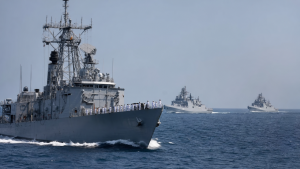
India’s maritime security strategy in the Indian Ocean Region is built around protecting sea lanes of communication, deterring non-traditional threats, and preserving regional stability. It combines doctrinal updates, multilateral coordination, and domestic naval modernization to support India’s wider strategic and economic interests.
Doctrinal Evolution and Policy Frameworks
The Indian Navy has refined its operational thinking to respond to changing geopolitical realities in the Indo-Pacific. Its public doctrine and strategy documents outline the navy’s approach to maritime security, force deployment, and regional engagement.
- Indian Maritime Doctrine 2025 (IMD-25): The navy’s primary doctrinal statement. It formalizes No War No Peace operational parameters and treats the Indo-Pacific as a connected strategic continuum.
- Indian Navy Maritime Security Strategy 2026 (INMSS-2026): The navy’s third public strategy document, following Freedom to Use the Seas (2007) and Ensuring Secure Seas (2015). It addresses current maritime challenges and operational priorities.
- SAGAR and MAHASAGAR: SAGAR (Security and Growth for All in the Region) remains India’s guiding maritime vision. The newer MAHASAGAR framework has raised the need for clearer alignment between overlapping policy objectives.
Regional Security Architectures and Forums
India uses regional forums and maritime information-sharing platforms to counter piracy, smuggling, illegal fishing, and other maritime crimes. These institutions help build practical cooperation with Indian Ocean partners.
- Colombo Security Conclave (CSC): Upgraded in April 2026 from a loose dialogue into a formal regional security organization with a permanent secretariat in Colombo, Sri Lanka.
- CSC membership: Six full members — India, Sri Lanka, Maldives, Mauritius, Bangladesh, and Seychelles. Seychelles became a full member in November 2025.
- Goa Maritime Conclave (GMC-26): The 5th edition was held on February 21, 2026. It supports real-time information exchange and coordination against IUU fishing, human trafficking, and transnational maritime crimes.
- Information Fusion Centre – Indian Ocean Region (IFC-IOR): Located in Gurugram, it hosts international liaison officers and helps track merchant shipping and coordinate joint responses to non-traditional threats.
Domestic Institutional Security Mechanisms
India’s maritime security architecture also relies on domestic coordination mechanisms that link the navy, civilian authorities, and shipping regulators. These institutions are meant to improve response times and protect Indian seafarers and vessels.
- National Maritime Security Coordinator (NMSC): Retired Vice Admiral Biswajit Dasgupta assumed charge in April 2025, succeeding retired Vice Admiral G. Ashok Kumar, the country’s first coordinator.
- Role of the NMSC: Ensures coordination among civilian and military maritime agencies and supports integrated decision-making on maritime security issues.
- Maritime Security Branch, Directorate General of Shipping: Established under DGS Order No. 2 of 2023, it coordinates with the Indian Navy, Ministry of External Affairs, and IFC-IOR.
- Operational focus: Protects Indian seafarers and merchant vessels from piracy, conflict-zone risks, and other regional threats.
Naval Modernization and Indigenous Inductions
India has accelerated indigenous warship construction to strengthen its maritime posture and expand blue-water capability. The emphasis is on stealth frigates, survey vessels, and anti-submarine platforms.
- INS Taragiri (F41): A Project 17A stealth frigate built by Mazagon Dock Shipbuilders Limited (MDL), commissioned on April 3, 2026.
- INS Mahendragiri (F38): The sixth Project 17A Nilgiri-class indigenous stealth frigate built by MDL, commissioned at Visakhapatnam on July 11, 2026.
- INS Dunagiri: Commissioned on June 21, 2026, as a Project 17A stealth frigate.
- INS Sanshodhak: Commissioned on June 21, 2026 as a survey vessel.
- INS Agray: Commissioned on June 21, 2026 as an anti-submarine warfare shallow water craft.
- Simultaneous commissioning at Kolkata: These three indigenously designed vessels were commissioned together on June 21, 2026, reflecting growing domestic shipbuilding capability.
Strategic Significance for the Indian Ocean Region
India’s maritime strategy is designed to secure critical sea lanes, reduce vulnerability to non-traditional security threats, and reinforce its role as a preferred security partner in the Indian Ocean. The strategy combines doctrine, regional partnerships, and indigenous capacity building.
- Sea lane security: Protects vital routes carrying trade, energy supplies, and strategic cargo through the Indian Ocean.
- Non-traditional threats: Addresses piracy, smuggling, IUU fishing, human trafficking, and maritime crime.
- Regional stability: Uses institutions and forums to support coordinated security responses among littoral states.
- Force modernization: Indigenous warship inductions improve deterrence and operational reach.
- Institutional coordination: Links military, diplomatic, and shipping-sector mechanisms for faster maritime response.
Key Prelims Takeaways
- IMD-25: India’s primary doctrinal statement for naval operations in the Indo-Pacific.
- No War No Peace: A formalized operational parameter under IMD-25.
- INMSS-2026: The Indian Navy’s third public maritime strategy document, after the 2007 and 2015 editions.
- CSC: A formal regional security organization with a permanent secretariat in Colombo.
- CSC members: India, Sri Lanka, Maldives, Mauritius, Bangladesh, and Seychelles.
- IFC-IOR: Based in Gurugram for maritime information fusion and coordination.
- NMSC: Retired Vice Admiral Biswajit Dasgupta has served as coordinator since April 2025.
| Related | |
|---|---|