National Disaster Management Act, 2005 and Key Provisions
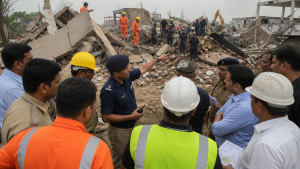
The Disaster Management Act, 2005 is India’s principal law for disaster risk reduction, mitigation, capacity building and emergency response. It provides the statutory framework for coordination at the national, state and district levels and creates dedicated institutions, funds and response forces.
Three-tier institutional framework
The Act is designed around a decentralized structure so that planning and response can take place at the level closest to the event. It assigns clear roles to national, state and district authorities and also requires local bodies to participate in disaster management.
- National Disaster Management Authority (NDMA): Headed by the Prime Minister, it formulates national policy and approves the national disaster management plan.
- State Disaster Management Authority (SDMA): Headed by the Chief Minister, it coordinates state-level disaster management and approves the state plan.
- District Disaster Management Authority (DDMA): Headed by the District Collector, District Magistrate or Deputy Commissioner, it coordinates local execution, rescue and rehabilitation.
- Local authorities: Panchayati Raj institutions, municipalities and cantonment boards are required to take part in disaster management and train their personnel.
- National Executive Committee (NEC): Constituted under Section 8, it consists of Union secretaries of key ministries and assists the NDMA.
- State Executive Committee (SEC): Under Section 20, it is headed by the Chief Secretary and assists the SDMA.
Core functions and planning provisions
The Act provides the legal basis for disaster plans, coordination mechanisms and institutional preparedness. Its focus is not only on response but also on prevention, mitigation and capacity building.
- National planning: The original Act placed the preparation of the national disaster management plan with the NEC, while the NDMA approved the policy framework.
- State planning: The SEC earlier drafted the state disaster management plan and supported implementation under the SDMA.
- Local preparedness: District authorities and local bodies are meant to prepare and execute area-specific response measures.
- Risk reduction focus: The Act covers mitigation, preparedness, response, recovery and capacity building as part of an integrated system.
Funds, force and institutions
To support implementation, the Act creates dedicated funds and specialized institutions. These provide financial support, rescue capability and training support during disasters.
- National Disaster Response Fund (NDRF): Used for emergency response and relief at the central level.
- State Disaster Response Fund (SDRF): Used by states to meet response and relief expenditure.
- National Disaster Mitigation Fund (NDMF): Created under Section 47 for long-term risk-reduction projects.
- State and District Mitigation Funds: Intended for mitigation activities at lower administrative levels.
- National Disaster Response Force (NDRF): Established under Section 44, it is a specialized rescue force under the general superintendence of the NDMA, headed by a Director-General.
- National Institute of Disaster Management (NIDM): Set up under Section 42 for training, research, human resource development and policy advocacy.
Major changes brought by the 2025 amendment
The Disaster Management (Amendment) Act, 2025 introduced structural changes to improve planning, data use and urban disaster response. It also gave statutory recognition to some advisory mechanisms already used in practice.
- Shift in planning powers: The preparation of national and state disaster management plans has been shifted directly to the NDMA and SDMAs.
- Urban Disaster Management Authorities (UDMAs): Section 41A allows state governments to set up separate UDMAs for state capitals and cities with municipal corporations, excluding the NCT of Delhi and Chandigarh.
- Urban-specific planning: UDMAs are meant to prepare plans for local hazards such as heatwaves and flooding.
- Centralized disaster databases: The amendment mandates National and State Disaster Databases to compile risk assessments, mitigation plans, fund allocation, expenditure and real-time crisis data.
- Statutory recognition: The National Crisis Management Committee (NCMC) and the High-Level Committee (HLC) have been given formal statutory status.
- State Disaster Response Forces: State governments are expressly empowered to establish SDRFs and define their functions and service conditions.
- NDMA staffing autonomy: The NDMA can determine the number, category and nature of its staff with prior approval of the Central Government and may appoint experts and consultants.
Redefined concepts under the amendment
The 2025 amendment also updated important definitions to align the parent Act with current disaster-management practice.
- Definition of disaster: The amended Section 2(d) clarifies that “man-made causes” do not include law-and-order related matters or situations.
- Disaster risk reduction: This is now explicitly included within “disaster management” and refers to systematic efforts to reduce exposure and vulnerability.
- Preparedness: The amendment gives a structured definition covering readiness measures, capacity building and early-warning integration.
- Broader legal clarity: These updates strengthen the Act’s focus on prevention and resilience, not just response.
Key provisions for Prelims
- Primary law: The Disaster Management Act, 2005 is the main legislative framework for disaster management in India.
- Three-tier structure: NDMA, SDMA and DDMA form the core institutional architecture.
- Head of NDMA: The Prime Minister chairs the NDMA.
- Head of SDMA: The Chief Minister chairs the SDMA.
- Head of DDMA: The District Collector, District Magistrate or Deputy Commissioner heads the DDMA.
- Specialized response force: The NDRF is the dedicated national rescue force under the Act.
- Training institution: The NIDM is the main statutory institution for capacity building and research.
Key Prelims Takeaways
- NDMA: Headed by the Prime Minister and responsible for national policy and plan approval.
- SDMA: Headed by the Chief Minister and responsible for state-level coordination and plan approval.
- DDMA: Headed by the District Collector, District Magistrate or Deputy Commissioner for district-level execution.
- Funds: NDRF and SDRF meet response and relief needs; NDMF supports mitigation projects.
- Specialized institutions: NDRF handles rescue operations and NIDM handles training and research.
- 2025 amendment: Shifted plan preparation to NDMA and SDMAs and enabled UDMAs for selected urban areas.
- Definitions: The amendment clarified “disaster”, added disaster risk reduction explicitly and defined preparedness more clearly.
| Related | |
|---|---|