NASA Tests Plasma Engine for Mars Travel
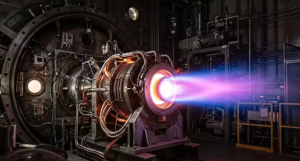
NASA’s Jet Propulsion Laboratory in Southern California tested a lithium-fed magnetoplasmadynamic (MPD) thruster on 24 February 2026. The prototype reached 120 kilowatts of power, which is the highest-power electric propulsion system tested in the United States to date.
Magnetoplasmadynamic Thruster
A magnetoplasmadynamic thruster is an electric propulsion device that uses electromagnetic fields to accelerate ionised propellant. The tested prototype used lithium metal vapour as fuel and produced a plume during operation.
Power and Thermal Features
The 120-kilowatt output is 25 times higher than the electric thrusters used on NASA’s Psyche mission. During the test, the central tungsten electrode exceeded 5,000 degrees Fahrenheit, or 2,800 degrees Celsius.
Mars Mission Propulsion Requirements
NASA estimates that crewed Mars missions may require 2 to 4 megawatts of power for propulsion. The thrusters may need to operate continuously for more than 23,000 hours, which is about 2.6 years.
Important Facts for Exams
- NASA’s Psyche mission uses electric thrusters for deep-space travel.
- One kilowatt equals 1,000 watts, and one megawatt equals 1,000 kilowatts.
- Electric propulsion systems are used in spacecraft for efficient long-duration thrust.
- Nuclear Electric Propulsion uses a small nuclear reactor to generate electricity for thrusters.
Nuclear Electric Propulsion
Nuclear Electric Propulsion, or NEP, uses small nuclear reactors to supply continuous electricity for electromagnetic thrusters in deep space. NASA has linked this propulsion concept with future Mars missions.
Mars Travel Time
Traditional Mars journeys take about nine months with current propulsion methods. NASA has stated that advanced electric propulsion could reduce the travel time to about 30 to 60 days.
| Related | |
|---|---|