NASA Launches Roman Space Telescope on Falcon Heavy
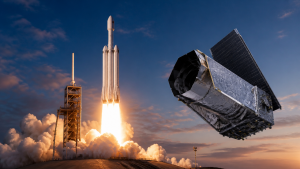
The Nancy Grace Roman Space Telescope launched on 30 August 2026 at 7:26 a.m. EDT aboard a SpaceX Falcon Heavy rocket from Launch Complex 39A at NASA’s Kennedy Space Center in Florida. The $4.3 billion observatory separated from the Falcon Heavy upper stage 31 minutes after liftoff and began a three-month journey to its science orbit near the Sun-Earth Lagrange Point 2, about 1 million miles from Earth.
Roman Space Telescope
The Nancy Grace Roman Space Telescope is a NASA flagship observatory with a mass of about 18,000 pounds. The mission has a planned five-year science phase and carries a 300-megapixel Wide Field Instrument.
Launch Vehicle and Recovery
The Falcon Heavy is a heavy-lift launch vehicle developed by SpaceX and uses three Falcon 9-derived cores. After stage separation, the two side boosters landed at Landing Zones 2 and 40 at Cape Canaveral Space Force Station in Florida.
Mission Orbit and Communications
Sun-Earth Lagrange Point 2, or L2, is one of the five Lagrange points in the Sun-Earth system. Controllers established communication through the Tracking and Data Relay Satellite, and tracking later shifted to the Canberra complex of NASA’s Deep Space Network.
Important Facts for Exams
- The Nancy Grace Roman Space Telescope is named after Nancy Grace Roman, NASA’s first chief astronomer.
- Sun-Earth Lagrange Point 2 lies on the line joining the Sun and Earth, beyond Earth’s orbit.
- The Wide Field Instrument on Roman has a field of view about 100 times larger than that of the Hubble Space Telescope.
- NASA uses the Deep Space Network for communication with spacecraft beyond low-Earth orbit.
Science Objectives
The Roman mission is designed to study dark energy, dark matter, and exoplanets. The telescope’s wide-field survey capability supports large-area observations in infrared astronomy.
| Related | |
|---|---|