Major Armistices and Peace Treaties in Modern Asia
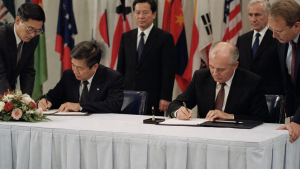
Armistices and peace treaties are distinct instruments for ending or managing conflict. Their terms may halt fighting, define post-war arrangements and create mechanisms for peacebuilding, while unresolved disputes can leave regional tensions in place.
Armistices, Peace Treaties and the Post-war Settlement
An armistice is a formal agreement to stop fighting. It generally suspends hostilities but does not itself create a final peace settlement; negotiations may continue afterwards. A peace treaty formally ends a war and may address borders, reparations, prisoners of war and disarmament. The distinction matters where an armistice remains in force without a treaty. The end of the Second World War produced important agreements affecting Asia:
- Instrument of Surrender: Japan signed it aboard the USS Missouri on 2 September 1945, formally ending the Second World War.
- Treaty of San Francisco: The Treaty of Peace with Japan was signed on 8 September 1951. It formally ended the war between Japan and most Allied powers.
- Signatories: The United States, the United Kingdom, France and many other nations signed the treaty; China and the Soviet Union did not.
- Terms and significance: Japan was stripped of its colonies and required to accept the judgments of the International Military Tribunal for the Far East. The treaty helped enable Japan’s post-war reconstruction and return to the international community.
These settlements illustrate how formal agreements can close a conflict while also setting terms for a country’s post-war position and international relations.
Korean War Armistice
The Korean War, fought from 1950 to 1953, ended in an armistice, not a peace treaty. The agreement was signed at Panmunjom on 27 July 1953 by the United Nations Command, the Korean People’s Army of North Korea and the Chinese People’s Volunteer Army.
- It established a Military Demarcation Line (MDL) and a Demilitarized Zone (DMZ) across the peninsula.
- It called for a cessation of armed force pending a final peace settlement and addressed the repatriation of prisoners of war.
- The Military Armistice Commission (MAC) and Neutral Nations Supervisory Commission (NNSC) were created to oversee compliance.
A peace treaty has not been concluded. The Korean Peninsula is divided between the Democratic People’s Republic of Korea (DPRK) in the north and the Republic of Korea (ROK) in the south. The absence of a final settlement shows the limits of an armistice as a conflict-resolution instrument: it can stop large-scale fighting without resolving the political conflict.
Vietnam War Peace Accords
The Paris Peace Accords, formally the Agreement on Ending the War and Restoring Peace in Vietnam, were signed in Paris on 27 January 1973. The parties represented were the Democratic Republic of Vietnam (North Vietnam), the Provisional Revolutionary Government of the Republic of South Vietnam (Viet Cong), the Republic of Vietnam (South Vietnam) and the United States.
- The accords called for a ceasefire throughout Vietnam and the withdrawal of all remaining US troops within 60 days.
- They provided for the release of all prisoners of war and established an International Commission of Control and Supervision (ICCS).
- The political future of South Vietnam was to be decided through peaceful means.
The agreement did not prevent the collapse of South Vietnam and the reunification of Vietnam under communist rule in 1975. Its outcome highlights the difficulty of sustaining peacebuilding when an agreement’s political provisions do not prevent renewed conflict.
Indo-Pakistani Agreements
The Tashkent Agreement followed the 1965 Indo-Pakistani War. It was signed on 10 January 1966 by Indian Prime Minister Lal Bahadur Shastri and Pakistani President Ayub Khan, with Soviet mediation.
- Both countries committed to withdrawing armed personnel to positions held before 5 August 1965.
- They pledged non-interference in each other’s internal affairs and renounced the use of force.
The Shimla Agreement was signed on 2 July 1972, after the 1971 war and the creation of Bangladesh. Its signatories were Indian Prime Minister Indira Gandhi and Pakistani President Zulfikar Ali Bhutto.
- It sought to normalise relations and establish a durable peace.
- It required differences to be settled by peaceful means through bilateral negotiations.
- It designated the 17 December 1971 ceasefire line in Jammu and Kashmir as the Line of Control (LoC).
Together, the agreements show how bilateral commitments and regional cooperation can support conflict resolution, while leaving the parties responsible for carrying out their terms.
Afghanistan: Bonn and Doha Agreements
The Bonn Agreement was signed in Germany on 5 December 2001, after the US-led invasion toppled the Taliban regime. It established an Afghan Interim Authority headed by Hamid Karzai and set out a framework for rebuilding state institutions.
- The agreement laid the groundwork for a new constitution, a national army and democratic elections.
- Its objective was a stable, representative government and the reconstruction of Afghan institutions.
The Doha Agreement was signed by the United States and the Taliban in Qatar on 29 February 2020.
- It provided for the complete withdrawal of US and NATO troops from Afghanistan.
- The Taliban committed to preventing terrorist groups from using Afghan soil to threaten the security of the United States and its allies.
- It paved the way for intra-Afghan negotiations on a post-war government, but the talks did not prevent the Taliban takeover in 2021.
Key Prelims Takeaways
- An armistice suspends fighting; a peace treaty formally ends a war.
- Japan signed the Instrument of Surrender on 2 September 1945; the Treaty of San Francisco followed in 1951.
- The Korean War armistice was signed at Panmunjom on 27 July 1953; no peace treaty has been concluded.
- The Paris Peace Accords of 1973 provided for a ceasefire and US troop withdrawal from Vietnam.
- The Tashkent Agreement followed the 1965 Indo-Pakistani War; the Shimla Agreement followed the 1971 war and named the LoC.
- The Bonn Agreement established an interim Afghan administration; the Doha Agreement provided for US and NATO troop withdrawal.
Recent Context
North Korea reportedly conducted an underwater test of its Zam-2.0 torpedo system, said to use artificial intelligence for target detection and guidance. The report is relevant to the Korean Peninsula’s security environment, where the 1953 armistice remains in place without a subsequent peace treaty.
| Related | |
|---|---|