Korean Peninsula: Countries and Strategic Significance
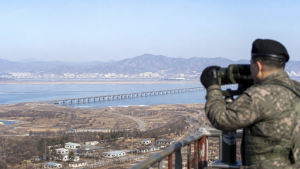
The Korean Peninsula is divided between the Democratic People’s Republic of Korea (DPRK) in the north and the Republic of Korea (ROK) in the south. Its post-war division, military stand-off and location among major powers make it a central issue in East Asian security and international relations.
Geography and Political Entities
The peninsula extends southward from continental Asia. China lies to its north and Russia to its northeast; the East Sea (Sea of Japan) is to the east and the Yellow Sea to the west. Its predominantly mountainous terrain and surrounding seas shape its geography and strategic setting.
- Democratic People’s Republic of Korea (DPRK): Commonly called North Korea, it has its capital at Pyongyang and operates under a centrally controlled political and economic system.
- Republic of Korea (ROK): Commonly called South Korea, it has its capital at Seoul and is a democratic republic with a market economy.
- Demilitarized Zone (DMZ): The approximately 250-kilometre-long and 4-kilometre-wide buffer zone separates the two Koreas. Established after the Korean War armistice, it is among the world’s most heavily fortified borders.
Historical Context: Korean War and Armistice
Following the end of Japanese colonial rule in 1945, the Soviet Union occupied the north and the United States the south. The resulting division reflected the wider post-Second World War geopolitical split and preceded the Korean War.
- War begins: North Korea invaded South Korea on 25 June 1950. A United Nations Command-led coalition, primarily led by the United States, intervened in support of South Korea.
- China’s intervention: China entered the conflict on North Korea’s side in October 1950.
- Armistice: The agreement signed on 27 July 1953 halted hostilities. It was an armistice, not a peace treaty; no formal peace treaty has since been concluded.
- Signatories: The United States signed on behalf of the UN Command, alongside North Korea and China. South Korea did not sign the armistice.
The absence of a peace treaty means the conflict was not formally resolved, and the military division remains a defining feature of relations between the two states.
Economic and Social Divergence
Since division, the two Koreas have followed sharply different economic and social paths.
- North Korea: Its centrally planned command economy is heavily reliant on state control and military spending. International sanctions are associated with its nuclear and missile programmes.
- South Korea: It has a highly developed, export-oriented market economy and is a global leader in technology, automotive and shipbuilding industries. It is also a member of the G20.
- Human development: South Korea ranks highly on human development measures. North Korea faces significant challenges in food security, healthcare and human rights.
These differences matter to regional affairs: South Korea’s economic role gives instability on the peninsula potential consequences beyond the two states, while the North’s weapons programmes are a persistent source of international concern.
Strategic Significance
The peninsula’s location, military stand-off and weapons developments connect local security concerns with wider regional and global interests.
- Geopolitical position: It lies among major powers including China, Russia, Japan and the United States. A conflict could therefore have far-reaching international consequences.
- Nuclear proliferation: North Korea’s development of nuclear weapons and ballistic missiles challenges regional stability and global non-proliferation efforts.
- Military balance: The United States Forces Korea (USFK) presence in South Korea is a key component of East Asian security and is described as balancing China’s growing influence.
- Economic exposure: Disruption could affect global supply chains and financial markets, given South Korea’s position as a major economy.
- Maritime routes: The seas around the peninsula are important for international trade and naval movements.
- Weapons and defence: North and South Korea are developing weapons systems intended to evade missile defences, adding to regional security concerns.
International Relations and Security Dynamics
The alliances and external relationships of the two Koreas are central to the peninsula’s security environment.
- South Korea and the United States: The countries maintain a robust security alliance that includes a mutual defence treaty. South Korea also has strong economic and political ties with Japan and European nations.
- North Korea and China: China is North Korea’s primary economic partner and a diplomatic supporter. North Korea also maintains relations with Russia.
- Denuclearisation diplomacy: The Six-Party Talks brought together China, Japan, North Korea, Russia, South Korea and the United States to pursue denuclearisation of the Korean Peninsula. The talks have largely stalled.
Nuclear proliferation, regional security and international relations are closely linked: developments on the peninsula affect the interests of neighbouring states and the wider non-proliferation framework.
Key Prelims Takeaways
- The peninsula is divided between the DPRK (North Korea) and the ROK (South Korea).
- Pyongyang is the capital of North Korea; Seoul is the capital of South Korea.
- The DMZ separates the two Koreas and was established after the Korean War armistice.
- The Korean War began in 1950; the armistice was signed on 27 July 1953.
- No formal peace treaty has been concluded; South Korea did not sign the armistice.
- The Six-Party Talks involved China, Japan, North Korea, Russia, South Korea and the United States.
Recent Context
North Korea said it tested the Zam-2.0 underwater torpedo on 15 October 2026; KCNA announced the test on 17 October, citing AI-assisted target detection and guidance. It also reported testing two types of submarine-launched strategic cruise missiles on 14 October. Some experts questioned the extent of its weapons-related AI capabilities.
| Related | |
|---|---|