National Institutions for Biodiversity Research in India
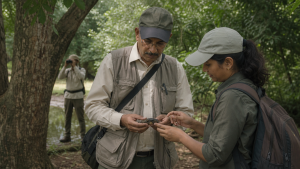
National institutions support biodiversity research through species surveys, taxonomic work, conservation planning and policy advice. Their distinct mandates—from documenting flora and fauna to monitoring forests and regulating access to biological resources—also make scientific capacity building and institutional coordination important to conservation.
Zoological and Botanical Surveys
The Zoological Survey of India (ZSI), established on July 1, 1916, is the country’s premier taxonomic research organisation for animal life. Headquartered in Kolkata and functioning under the Ministry of Environment, Forest and Climate Change (MoEFCC), it promotes surveys, exploration and research into India’s faunal diversity. ZSI maintains the National Zoological Collections, a national repository of type and voucher specimens. The collections hold over 5.5 million specimens representing 103,920 species. ZSI has 16 regional centres; its Western Ghat Regional Centre (WGRC) in Kozhikode was established in 1980. Its work includes environmental impact assessments, conservation-area surveys and endangered-species status surveys. It also undertakes DNA molecular studies, cyto-taxonomy, GIS studies and wildlife forensic work. These functions link taxonomy and field research with conservation and environmental assessment. The Botanical Survey of India (BSI) is the apex organisation for floristic and taxonomic studies and the conservation of wild plant resources. Formally instituted on February 13, 1890, under the direction of George King, it is headquartered in Kolkata and functions under MoEFCC. BSI surveys plant resources for national, regional and district floras, develops herbaria as repositories of specimens, and establishes botanical gardens for study and conservation. Its taxonomic research covers angiosperms, gymnosperms, pteridophytes, fungi, algae, bryophytes, lichens and microbes. Other work includes Red List assessments, in-situ and ex-situ conservation, and documenting plant-based traditional knowledge. BSI publishes Plant Discoveries annually and Nelumbo biannually.
Wildlife Institute of India
The Wildlife Institute of India (WII), established in 1982 at Dehradun, Uttarakhand, is an autonomous institution under MoEFCC. It serves as a national centre for wildlife research, training and conservation advice. WII was established to build a cadre of professionally trained wildlife managers and develop the field-research base for statutory conservation programmes. Its activities include training, academic courses such as the Post Graduate Diploma and M.Sc. in Wildlife Science, and research on ecological issues. The institute advises central and state governments, conducts environmental impact assessments and prepares management plans for protected areas. It also maintains the National Wildlife Database and is the technical executor of the All India Tiger Estimation.
National Biodiversity Authority
The National Biodiversity Authority (NBA) is a statutory autonomous body established in 2003 under the Biological Diversity Act, 2002. Headquartered in Chennai, Tamil Nadu, it implements the Act’s objectives: conserving biodiversity, ensuring sustainable use of its components, and securing fair and equitable sharing of benefits arising from the use of biological resources. The NBA regulates access to India’s biological resources and advises the Central Government on biodiversity conservation. Its functions include identifying biodiversity heritage sites and taking steps to prevent the grant of intellectual property rights over indigenous biological resources and associated traditional knowledge. The Act provides for a decentralised, three-tier structure: the NBA at the national level, State Biodiversity Boards (SBBs) at the state level, and Biodiversity Management Committees (BMCs) at the local level. This framework connects national regulation with state and community-level biodiversity management.
Forestry Research and Forest Assessment
The Indian Council of Forestry Research and Education (ICFRE) is an autonomous organisation under MoEFCC, established in 1986 and headquartered in Dehradun. It promotes and coordinates forestry research, education and extension to support the scientific and sustainable management of forest resources. ICFRE undertakes solution-based research on climate change, conservation of biological diversity, combating desertification and sustainable resource management. It also administers India’s Green Credits Program. The Forest Survey of India (FSI), also under MoEFCC, originated as the Pre-Investment Survey of Forest Resources in 1965 and was reorganised as FSI in 1981. Its principal mandate is to survey and assess India’s forest resources. Activities include forest inventory, forest-cover mapping and forest-fire monitoring. FSI publishes the biennial India State of Forest Report (ISFR), which provides information on forest cover, tree cover and other forest resources.
Coordination and Conservation Mandate
MoEFCC is the nodal ministry for planning, promoting and coordinating environmental and forestry policies and programmes. Its responsibilities include the conservation and survey of flora, fauna, forests and wildlife, pollution prevention and control, afforestation, and protection of the environment. It also facilitates India’s commitments under international agreements such as the Convention on Biological Diversity (CBD) and is the cadre-controlling authority for the Indian Forest Service. The institutions have complementary roles: ZSI and BSI document animal and plant diversity; WII supports wildlife research and management; NBA implements the biodiversity law; and ICFRE and FSI contribute forestry research and resource assessment. Effective coordination among them strengthens biodiversity documentation, scientific capacity building and the use of research in conservation policy.
Key Prelims Takeaways
- ZSI: Established on July 1, 1916; headquartered in Kolkata; holds over 5.5 million zoological specimens representing 103,920 species.
- WGRC: ZSI’s Western Ghat Regional Centre is in Kozhikode and was established in 1980.
- BSI: Instituted on February 13, 1890; headquartered in Kolkata; focuses on floristic and taxonomic research.
- WII: Established in 1982 at Dehradun; provides wildlife research, training and conservation advice.
- NBA: Statutory body under the Biological Diversity Act, 2002; headquartered in Chennai.
- Biodiversity governance: The Act provides for the NBA, SBBs and local BMCs.
- Forest assessment: FSI publishes the biennial ISFR; ICFRE coordinates forestry research, education and extension.
Recent Context
Three new centipede species in the genus Rhysida were described from southern India, including the Western Ghats, through research involving ZSI’s WGRC. The discovery raised India’s known Rhysida species count to 23, illustrating the continuing role of taxonomic surveys in documenting faunal diversity.
| Related | |
|---|---|