Major Aquatic Plants and Their Adaptations
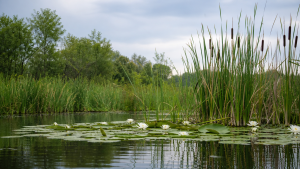
Aquatic plants, or hydrophytes, live submerged, float on the water surface, or grow along water margins. Their structures are adapted to water’s effects on light, gas exchange, support and nutrient availability. These adaptations also help maintain freshwater and marine ecosystems.
Types of Aquatic Plants
Aquatic plants are commonly grouped by where they grow in relation to the water surface and substrate. The categories help explain differences in their roots, leaves and support structures.
- Emergent plants: Rooted in the substrate, they extend stems and leaves above the water. Reeds, cattails and some sedges are examples. Their firm stems and air-filled tissues support growth above the surface and aid gas exchange.
- Floating-leaved plants: Rooted in the substrate, these plants hold their leaves at the surface. Water lilies (Nymphaea) and lotus (Nelumbo) have broad leaves and long petioles that bring foliage into the light.
- Free-floating plants: These are not anchored to the substrate and drift at the surface. Water hyacinth, duckweed and water lettuce are examples; air-filled tissues aid flotation, while roots may hang in the water.
- Submerged plants: Growing below the surface, they may be rooted or free-floating. Hydrilla, Vallisneria and pondweed (Potamogeton) have leaves suited to exchanging gases and nutrients directly with the water.
- Amphibious plants: These can grow in water and on land, adapting to changing water levels. Watercress and some rushes are examples.
Structural and Physiological Adaptations
Water provides buoyancy but also changes how plants obtain gases, capture light and remain upright. Hydrophytes show several structural and physiological responses to these conditions.
- Aerenchyma: This spongy tissue contains large air spaces, particularly in stems and roots. It supports buoyancy and helps move oxygen to submerged parts and carbon dioxide to photosynthetic tissues.
- Epidermis and stomata: Submerged plants often have a reduced or absent cuticle, allowing water, nutrients and gases to pass directly across the surface. Stomata are usually absent or non-functional on submerged leaves. Floating leaves generally have stomata on the upper surface, while emergent plants may have them on both surfaces.
- Roots and mechanical support: Roots can be reduced or absent in free-floating and some submerged plants; where present, they may mainly anchor the plant. Buoyancy and turgor provide support, so woody and stiffening tissues are often reduced.
- Leaf form: Submerged leaves are often thin, ribbon-like or finely divided, increasing surface area for exchange while reducing resistance to water currents. Floating leaves are generally broad and flat, with flexible petioles that position them at the surface for light capture.
- Heterophylly and osmotic regulation: Some species produce different leaf forms in submerged and emergent conditions; Ranunculus aquatilis is an example of heterophylly. Aquatic plants also regulate cell solute concentrations; in freshwater, their osmotic concentrations are often lower than those of terrestrial plants.
Representative Aquatic Plants
Differences among familiar species illustrate how aquatic adaptations relate to growth form and ecological effects.
- Water lily (Nymphaea): A rooted, floating-leaved plant with large circular leaves and showy flowers. Its foliage can provide habitat, as well as aesthetic value.
- Lotus (Nelumbo nucifera): A rooted plant with floating leaves. The leaves’ superhydrophobic, self-cleaning surface is known as the “Lotus effect.”
- Water hyacinth (Eichhornia crassipes): This free-floating plant has swollen, air-filled petioles and is native to South America. Its rapid proliferation has made it a prominent invasive alien species; dense growth can deplete oxygen and block waterways.
- Hydrilla and duckweed: Hydrilla (Hydrilla verticillata) is a rooted submerged plant that can form dense mats and outcompete native vegetation. Duckweed (Lemna minor) is a tiny free-floating flowering plant that reproduces rapidly and can absorb nutrients and pollutants, supporting its use in bioremediation.
Ecosystem Functions and Conservation
Aquatic plants contribute to ecosystem functioning and freshwater biodiversity, but habitat degradation and invasive species can undermine these benefits.
- Habitat and food: Plant communities provide food and shelter for aquatic fauna, supporting biodiversity in freshwater and marine systems.
- Water and sediment: Plants stabilise sediments, help prevent erosion, contribute oxygen through photosynthesis and take part in nutrient cycling and water purification.
- Conservation concerns: Habitat destruction, pollution and invasive plants threaten native aquatic vegetation. Protecting wetlands, controlling invasive species and restoring native plant communities are key conservation approaches.
Key Prelims Takeaways
- Hydrophytes: Plants adapted to living in water.
- Aerenchyma: Air-filled tissue that aids buoyancy and gas exchange.
- Leaf adaptations: Submerged leaves are often thin or dissected; floating leaves are broad.
- Stomata: Typically on the upper surface of floating leaves; reduced or absent on submerged leaves.
- Invasive examples: Water hyacinth and Hydrilla can affect native vegetation and aquatic habitats.
- Lotus effect: The superhydrophobic, self-cleaning property of lotus leaves; heterophylly means different leaf forms on one plant.
Recent Context
On October 9, 2026, Victoria colombiana was formally identified in Phytotaxa as the fourth scientifically recognised species in the genus Victoria. Native to South American freshwater habitats, it is critically endangered; an estimated 30–50 plants survive in Colombia’s Inírida region.
| Related | |
|---|---|