Sports Diplomacy and International Cooperation
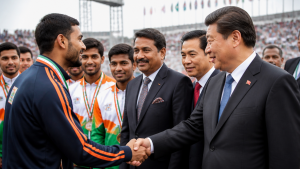
Sports diplomacy uses athletic exchange and competition to create channels for dialogue, cultural understanding and international cooperation. It can support foreign-policy goals, strengthen bilateral relations and project soft power while bringing people together across political differences.
Understanding Sports Diplomacy
Sports diplomacy is a form of public diplomacy in which sporting activities help advance national and international objectives. It includes hosting competitions, participating in international events, and arranging exchanges among athletes and coaches. Shared sporting experiences can encourage mutual respect and help build positive perceptions of a country. Its relevance extends beyond the field of play. Sporting contacts can sustain communication where formal political engagement is limited, while international events create opportunities for interaction among leaders, institutions and the public. By sharing sporting skills and practices, countries can also support capacity building. Sports diplomacy therefore links international relations with cultural exchange and the projection of national values.
Historical Evolution and Key Milestones
The ancient Olympic Truce is an early example of sport being associated with peace and cooperation. In the modern era, sports diplomacy became especially visible after the Second World War, as international competitions and exchanges offered opportunities for contact between countries. A notable case was “Ping-Pong Diplomacy” in 1971, when American table tennis players visited China. The exchange helped thaw relations between the United States and China and preceded broader diplomatic engagement. The episode illustrates how sporting contact can open a channel for dialogue, although it does not replace formal diplomacy. The Olympic Games, despite the Olympic Movement’s sporting ideals, have also provided settings for political statements and informal interactions between national leaders. Major competitions can draw global attention and create occasions for high-level discussions alongside athletic events.
International Sports Bodies
The International Olympic Committee (IOC) is the supreme authority of the Olympic Movement and promotes Olympism and its values worldwide. National Olympic Committees (NOCs) represent their respective countries within the Movement and are important partners in organising participation and sporting cooperation. The Indian Olympic Association (IOA) is India’s NOC. It coordinates India’s participation in major multi-sport events, including the Olympic Games, Commonwealth Games and Asian Games. NOCs may also establish bilateral arrangements with counterparts to develop sporting ties. International federations for individual sports contribute by organising championships and setting common rules and standards. These institutions connect athletes and national organisations across borders, enabling regular competition and cooperation.
Instruments and Objectives
Sports diplomacy operates through formal agreements as well as direct sporting and cultural contact. Common instruments include:
- Major events: Hosting the Olympic Games or world championships can attract international attention and provide opportunities for cultural exchange.
- Bilateral agreements: Governments, Olympic committees or other sporting organisations may use agreements and memoranda of understanding (MoUs) to organise cooperation.
- Athlete and coach exchanges: Visits and joint programmes can build personal connections and support the transfer of skills.
- Technical cooperation: Sharing expertise, training practices and sporting knowledge can contribute to capacity building.
- Scholarships and youth participation: Training opportunities abroad and events such as the Youth Olympic Games can foster goodwill and cross-cultural understanding.
These measures can strengthen institutional links as well as individual relationships. Their diplomatic value lies in creating sustained contact and shared interests; their effectiveness depends on meaningful cooperation beyond a single competition.
India, the Youth Olympic Games and Dakar 2026
India uses sporting participation, event hosting and bilateral cooperation to build international relationships and promote its sporting capabilities. The IOA has a central coordinating role, while agreements with other Olympic organisations provide a framework for exchanges and cooperation. The Youth Olympic Games (YOG) are an IOC event for young athletes. They combine competition with cultural exchange and educational programmes, and promote the Olympic values of excellence, friendship and respect. The inaugural Summer YOG took place in Singapore in 2010, followed by Nanjing in 2014 and Buenos Aires in 2018. The Dakar 2026 Summer YOG are scheduled to take place in Senegal from October 31 to November 13, 2026. They are the first Olympic event scheduled to be hosted on the African continent. Approximately 2,700 athletes from 207 delegations are expected to compete in 25 sports. The IOA announced a 17-member Indian contingent on October 26, 2026. The Indian team will compete in 11 sports, with athletes aged up to 17. The contingent includes table tennis players Sarthak Arya and Syndrela Das, swimmer Dhinidhi Desinghu and badminton player Tanvi Patri.
Key Prelims Takeaways
- Sports diplomacy uses sport to promote dialogue, cultural understanding and international relations.
- The IOC is the supreme authority of the Olympic Movement; NOCs represent their countries within it.
- The IOA is India’s National Olympic Committee.
- “Ping-Pong Diplomacy” involved the United States and China in 1971.
- The first Summer Youth Olympic Games were held in Singapore in 2010.
- Dakar 2026 is scheduled for October 31–November 13 in Senegal and is the first Olympic event scheduled for Africa.
Recent Context
In September 2026, IOA President P.T. Usha and the CEO of the Namibia National Olympic Committee discussed stronger sporting ties. During Dakar 2026, Usha is expected to sign MoUs with African NOCs, including those of Namibia and Mauritius, covering exchanges and technical cooperation.
| Related | |
|---|---|