Major Applications of AI and Semiconductor Chips
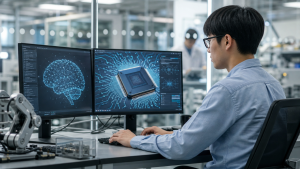
Artificial Intelligence and semiconductor chips are core technologies behind today’s digital systems. AI provides the software intelligence to analyse data, recognise patterns and make decisions, while chips supply the computing power needed to run those tasks at scale. Together, they support applications from healthcare and finance to defence, mobility and smart infrastructure.
Artificial Intelligence: Core Concepts
Artificial Intelligence refers to machines simulating human intelligence processes such as learning, reasoning and self-correction. It covers several approaches and forms, each with a different level of capability and use.
- Machine Learning (ML): A subset of AI in which systems learn from data without explicit programming and improve predictions or decisions over time.
- Deep Learning (DL): A branch of ML that uses multi-layered neural networks to identify complex patterns in large datasets. It is widely used in image and speech recognition.
- Narrow AI (Weak AI): AI designed for a specific task such as facial recognition, chess or language translation. Most existing AI systems belong to this category.
- General AI (Strong AI): A hypothetical form of AI that could understand, learn and apply intelligence across any intellectual task like a human being.
- Super AI: A hypothetical AI that would surpass human intelligence in nearly all fields.
Major Applications of AI
AI is increasingly used across sectors to improve speed, accuracy, prediction and automation. Its role is not limited to large industrial systems; it is also deeply embedded in everyday consumer services.
- Healthcare: Used in disease diagnosis, medical imaging analysis, drug discovery, personalised medicine and robotic surgery assistance.
- Finance: Supports fraud detection, algorithmic trading, credit scoring, risk assessment and personalised advisory services.
- Agriculture: Enables precision farming through crop yield prediction, pest and disease detection, automated irrigation and drone-based monitoring.
- Manufacturing: Helps in predictive maintenance, quality control, supply chain optimisation and robotic automation on production lines.
- Defence and Security: Used in surveillance systems, threat detection, autonomous vehicles, cybersecurity and intelligence analysis.
- Smart Cities and Infrastructure: Assists in traffic management, energy optimisation in smart grids, public safety monitoring and waste management.
- Transportation: Drives autonomous vehicles, route planning, logistics optimisation and intelligent traffic systems.
- Education: Supports personalised learning, automated grading and intelligent tutoring systems.
- Retail and E-commerce: Enables recommendations, chatbots, inventory management and demand forecasting.
Semiconductor Chips: Fundamentals and Types
Semiconductor chips, also called integrated circuits (ICs), are the basic building blocks of modern electronic devices. They are miniature circuits made on semiconductor material, usually silicon, and process or store information using electrical signals.
- Silicon: The most widely used semiconductor material because of its abundance and suitable electrical properties.
- Microprocessors (CPUs): The central processing unit of a computer, often described as its brain, which executes instructions and performs computations.
- Memory Chips: Store data temporarily or permanently. Examples include RAM and ROM.
- Graphics Processing Units (GPUs): Designed for parallel processing and widely used for graphics and computational workloads.
- System-on-Chip (SoC): Integrates processors, memory and input-output interfaces on a single chip. It is widely used in smartphones, surveillance systems, automotive electronics and industrial devices.
- Application-Specific Integrated Circuits (ASICs): Custom-built for a particular application, offering high performance and efficiency for targeted tasks.
Why Chips Are Critical for AI
AI, especially deep learning, is computationally intensive. Training and running AI models require chips that can process large datasets quickly and handle many operations in parallel. This makes semiconductor capability central to AI progress.
- Data Processing: Chips handle the large volumes of data needed to train AI models.
- Parallel Processing: GPUs are effective because deep neural network training involves many simultaneous calculations.
- AI Accelerators: Neural Processing Units (NPUs) and Tensor Processing Units (TPUs) are designed specifically to speed up AI and machine learning workloads.
- Edge AI: Low-power, efficient chips allow AI processing on devices themselves, reducing latency and bandwidth use.
- Memory Bandwidth: High-bandwidth memory helps supply data quickly to processors during AI operations.
Strategic Importance of the Semiconductor Ecosystem
The semiconductor industry is strategically important because it supports digital infrastructure, economic competitiveness and national security. Control over design and manufacturing reduces dependence on external supply chains and strengthens technological sovereignty.
- Global Supply Chains: The semiconductor chain includes design, fabrication, assembly, testing and packaging, often spread across multiple countries.
- Geopolitical Relevance: Trade restrictions, technology competition and supply disruptions can significantly affect semiconductor availability.
- India Semiconductor Mission (ISM): A government initiative to build a sustainable semiconductor and display ecosystem in India.
- Production Linked Incentive (PLI) Scheme: Provides financial incentives to boost domestic manufacturing and attract investment in semiconductor and display units.
- Design-Led Manufacturing: India aims to strengthen semiconductor design capabilities, where it already has a strong talent base.
- Research and Development: Support for materials science, chip architecture and manufacturing processes is essential for ecosystem growth.
- Talent Development: Skilled professionals are needed for chip design, fabrication and related advanced technologies.
Key Prelims Takeaways
- Artificial Intelligence (AI): AI simulates human intelligence in machines through learning, reasoning and self-correction.
- Machine Learning and Deep Learning: ML is a subset of AI, while DL uses multi-layered neural networks for complex pattern recognition.
- AI Categories: Narrow AI performs specific tasks; General AI is hypothetical human-like intelligence; Super AI would surpass human intelligence.
- Semiconductor Chips: Integrated circuits made mainly from silicon are the core hardware for modern electronics.
- System-on-Chip (SoC): An SoC integrates multiple components on a single chip and is widely used in smartphones, vehicles and industrial systems.
- AI Hardware: GPUs, NPUs and TPUs are important because AI workloads require heavy parallel processing and high memory bandwidth.
- Strategic Value: Semiconductor capability matters for digital sovereignty, supply-chain resilience, defence modernisation and industrial automation.
Recent Context
The Technology Development Board (TDB) under the Department of Science & Technology signed an agreement with Bengaluru-based BigEndian Semiconductors for Project VeerAI. The project receives ₹130 crore from the Research Development and Innovation (RDI) Fund as Optional Convertible Debt for an indigenous AI Vision SoC. It aims to move from TRL-5 to TRL-9 for secure use in surveillance, defence, automotive, industrial and medical applications.
| Related | |
|---|---|