Lumina Simulation Models the Universe’s First Two Billion Years
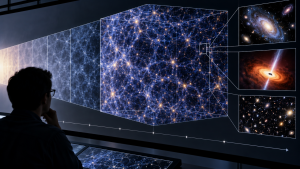
An international research team developed Lumina, a simulation modelling the universe’s first two billion years and the reionization of hydrogen and helium. The study, led by Oliver Zier of the Institute for Theory and Computation at the Center for Astrophysics, Harvard & Smithsonian, was published in Monthly Notices of the Royal Astronomical Society on 26 October 2026.
Scale and findings
Lumina spans approximately 1.5 billion light-years in each direction, covers more than 100 times the volume of earlier comparable simulations and offers 30 times greater sharpness. It resolves individual galaxies while modelling large-scale cosmic structure.
The simulation indicates that early stars primarily drove hydrogen reionization, while active supermassive black holes powered helium reionization. During this process, radiation stripped electrons from atoms, allowing light to travel farther. Lumina lets researchers track both elements’ changes simultaneously.
Computing and research use
More than 15,000 graphics processing units on Frontier, housed at Oak Ridge National Laboratory in Tennessee, ran for nearly three years to produce the simulation. Researchers can compare its predictions with telescope observations, including those from the James Webb Space Telescope, to test models of cosmic evolution.
Important Facts for Exams
- 21-cm probe: The neutral-hydrogen 21-cm line reflects an electron–proton spin-state energy difference; despite its rarity, it can probe the dark ages and reionization.
- Quasar spectra: Light from distant quasars passing through extensive neutral hydrogen can show a Gunn–Peterson trough, providing a spectral clue to reionization’s progress.
- CPU–GPU link: Frontier’s coherent CPU–GPU links let code running on its Epyc CPUs access GPU memory coherently.
| Related | |
|---|---|