Juno Detects Complex Plasma Waves at Jupiter’s Bow Shock
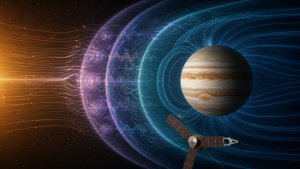
NASA’s Juno spacecraft detected complex plasma waves and multiple shock regions in Jupiter’s magnetic environment during observations in December 2024. The University of Iowa-led study, published online in Nature Communications on 31 July 2026, provides detailed observations of Jupiter’s bow shock, where the solar wind meets the planet’s magnetic environment.
Jupiter’s layered response to solar wind
Juno’s measurements show that Jupiter’s bow shock uses plasma waves at multiple frequencies, or harmonics, to slow and heat incoming solar particles. Earth’s bow shock is generally associated with waves concentrated around a single frequency. Researchers also identified smaller structures called shocklets, which can slow solar-wind particles before they reach Jupiter’s main bow shock.
The Juno Waves instrument, designed and built by University of Iowa physicists, measured electric and magnetic wave activity. Corresponding author Jayasri Joseph is a postdoctoral researcher in the university’s Department of Physics and Astronomy. Co-author Bill Kurth, a research scientist there, has worked on the Juno mission since its 2011 launch.
Relevance to astrophysical shocks
The researchers say studying Jupiter’s bow shock could help scientists examine energy transfer in more powerful environments, including supernova remnants.
Important Facts for Exams
- Planetary bow shock: For magnetised planets, the bow shock is the boundary where stellar-wind speed abruptly falls as the flow approaches the magnetopause.
- Solar wind plasma: Solar wind plasma consists mostly of electrons, protons and alpha particles, with the interplanetary magnetic field superimposed on it.
| Related | |
|---|---|