Interplanetary Coronal Mass Ejections Thermal Evolution
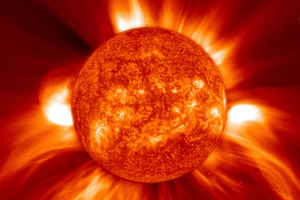
Interplanetary Coronal Mass Ejections (ICMEs) are large solar eruptions that travel from the Sun to Earth and interact with the solar wind and the geomagnetic field. A long-term statistical study by the Indian Institute of Astrophysics (IIA), Bengaluru, examined ICME thermal behaviour at 1 Astronomical Unit (AU) using observations from 1995 to 2024 across Solar Cycles 23, 24 and the rising phase of 25.
Interplanetary Coronal Mass Ejections
ICMEs are the interplanetary counterparts of coronal mass ejections (CMEs), which are massive expulsions of plasma and magnetic field from the solar corona. At 1 AU, the average Sun-Earth distance, ICME plasma can retain magnetic structure and thermodynamic properties that are measurable by spacecraft.
Thermal Behaviour and Solar Cycles
The study found that nearly 45% of magnetic ejecta showed heating signatures at 1 AU, especially near solar maximum. Earlier assumptions that ICMEs only cool during expansion were not supported by the full 29-year dataset. The analysis also recorded a shift from more heating-like states in Solar Cycle 23 to more cooling-dominated states in Solar Cycle 24.
Space Weather and Geomagnetic Effects
ICME thermal state is linked with the disturbance potential of solar storms in Earth’s magnetic environment. Such disturbances can affect radio communications, aviation routes, satellite operations, GPS signals and power grids. Space weather forecasting uses solar and heliospheric observations to estimate the arrival and impact of such eruptions.
Important Facts for Exams
- 1 Astronomical Unit is the mean distance between the Earth and the Sun, and it is about 149.6 million kilometres.
- Solar Cycle 23 began in 1996, Solar Cycle 24 began in 2008, and Solar Cycle 25 is the current cycle.
- Monthly Notices of the Royal Astronomical Society is a peer-reviewed astronomy journal published by Oxford University Press.
- Coronal mass ejections are among the main drivers of geomagnetic storms on Earth.
Research Method and Publication
The investigation used publicly available observations and was led by Soumyaranjan Khuntia and Wageesh Mishra. The findings were published in Monthly Notices of the Royal Astronomical Society by 1 July 2026.
| Related | |
|---|---|