India’s Major Reservoir Storage Falls to 28.28%
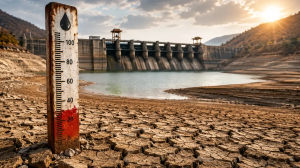
India’s 166 major reservoirs held 51.92 billion cubic metres of live storage on 11 June 2026, which was 28.28% of their total live storage capacity of 183.56 billion cubic metres. The Central Water Commission monitors reservoir storage across major river basins in India for water supply, irrigation, and hydropower planning.
Reservoir Storage in India
Reservoir storage is measured as live storage, which is the usable water volume between the minimum drawdown level and the full reservoir level. India’s major reservoirs are grouped for monitoring by the Central Water Commission, which publishes weekly storage data for 166 large reservoirs across the country.
Regional Storage Pattern
Southern India’s reservoirs stood at 20.98% of capacity as of 15 June 2026, and Eastern India’s reservoirs were below both last year’s level and the normal level for the season. Northern and central Indian reservoirs were in a comparatively better position than the same period in 2025.
Monsoon Rainfall and Water Availability
India received 46.2 mm rainfall in the first 17 days of June 2026 against a normal of 74.3 mm for the period. The cumulative monsoon rainfall deficit was nearly 40% as of 20 June 2026, and reduced rainfall can affect irrigation, drinking water supply, and hydropower generation.
Important Facts for Exams
- The Central Water Commission is the apex technical organisation for water resources in India.
- Live storage is different from gross storage because it excludes dead storage below the minimum drawdown level.
- India’s reservoir storage was 15.8% above the 10-year normal for the same period in 2026.
- India’s storage was 8.17% lower than the 56.53 billion cubic metres recorded in the same period of 2025.
States with Lower Storage
Several states, including Andhra Pradesh, Goa, Jharkhand, Karnataka, Kerala, Maharashtra, Meghalaya, Mizoram, Rajasthan, Tamil Nadu, Telangana, Tripura, and West Bengal, reported lower storage levels than a year earlier as of 20 June 2026. Chandan Dam, Bhima-Ujani, Maudaha, and Nanak Sagar were among the reservoirs reported to be nearly empty.
| Related | |
|---|---|