Indian Scientists Develop AI Sensor to Identify Snake Venom with 95% Accuracy
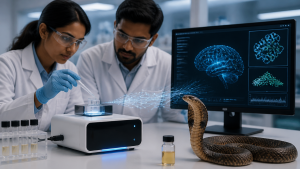
Indian researchers developed a laboratory sensor that distinguishes cobra venom from viper venom using liquid crystals and artificial intelligence. The study, published in Sensors and Actuators A: Physical, reported 95% identification accuracy and a sensing time of four minutes.
How the Sensor Works
The sensor uses a textile grid impregnated with liquid crystals. Contact with venom changes the grid’s optical appearance, creating patterns for analysis. A deep-learning model, MobileNetV3-Large, processes these patterns and classifies the sample as cobra or viper venom. The system detected both venom types at concentrations as low as 45 micrograms per millilitre. The research paper is titled “A deep learning-enhanced liquid crystal sensor for the rapid discrimination of snake venoms: A case study on cobra and viper”. The reported results concern cobra and viper venom; they do not establish identification of all snake species or venom types.
Snakebite Sensors and Antivenom
A separate biosensor developed by researchers from C-MET Thrissur and Kerala Bio measures the quantity of venom injected during a snakebite. The work was reported as of 16 July 2026, with the measured quantity intended to help guide antivenom dosage. Antivenom is an antibody-based treatment used to neutralise toxins in snake venom. In India, polyvalent antivenom is produced to target venom from four medically important snakes: the Indian cobra, common krait, Russell’s viper and saw-scaled viper. The AI sensor described in the study classifies cobra and viper venom, while the separate biosensor measures the amount injected.
Validation and Field Use
The liquid-crystal sensor has been tested as a laboratory platform, and further testing is required in medical settings. On 22 September 2026, AI tools were used by colleagues of a police officer in Gwalior, Madhya Pradesh, to identify the snake species involved in his bite; the identification helped guide his treatment, and he survived.
Important Facts for Exams
- The study’s sensor combines a liquid-crystal textile grid with the MobileNetV3-Large deep-learning model.
- The sensor reported 95% accuracy, a four-minute sensing time and detection at 45 micrograms per millilitre.
- India’s four-snake polyvalent antivenom targets the Indian cobra, common krait, Russell’s viper and saw-scaled viper.
- The separate C-MET Thrissur and Kerala Bio biosensor measures the amount of venom injected after a snakebite.
The reported AI sensor distinguishes cobra and viper venom, whereas the separate biosensor measures the quantity of injected venom. The liquid-crystal sensor requires further testing in real medical settings.
| Related | |
|---|---|