India Sets Foodgrain Production Target for 2026-27
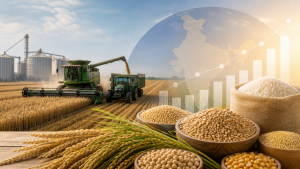
India fixed a foodgrain production target of 373.93 million tonnes for the 2026-27 crop year on 29 September 2026. The target is lower than the record output of 376.56 million tonnes achieved in 2025-26. The announcement was made by the Union Minister of Agriculture and Farmers’ Welfare, Shivraj Singh Chouhan.
Foodgrain Production in India
Foodgrain production in India covers cereals and pulses grown in the kharif and rabi seasons. Major cereals include rice, wheat, maize, jowar, bajra and barley, while major pulses include gram, tur, urad, moong and lentil. The crop year in India is commonly divided into kharif, rabi and summer seasons.
Kharif and Rabi Crop Seasons
Kharif crops are sown with the onset of the southwest monsoon and harvested in autumn. Rabi crops are sown in winter and harvested in spring. For 2026-27, the government set a rabi foodgrain target of 177.72 million tonnes, which is higher than the 171.14-174.51 million tonnes estimated or achieved in 2025-26.
- Kharif crops are generally dependent on monsoon rainfall and include rice, maize, cotton and soybean.
- Rabi crops are generally grown with residual soil moisture and irrigation support.
- Wheat is the principal rabi cereal in India.
- Rice is the principal kharif cereal in India.
Weather Factors and Crop Acreage
The lower target for 2026-27 factors in weather risks such as El Niño, uneven monsoon rainfall and drought-like conditions in some states. As of 18 September 2026, kharif crop acreage stood at 110.39 million hectares, about 1.5 million hectares lower than the previous year. Rice acreage fell by 3.7% year-on-year to 42.9 million hectares, while pulses acreage rose by 1.4% to 11.9 million hectares.
Important Facts for Exams
- El Niño is a periodic warming of the central and eastern equatorial Pacific Ocean.
- India’s foodgrain statistics are used in crop planning, procurement and buffer stock management.
- Kharif acreage is usually tracked after the southwest monsoon sowing period.
- Rice and wheat are the two most important staple cereals in India.
Food Security and Supply Risks
On 29 September 2026, S. Jaishankar referred to risks linked to fertiliser shortages, disrupted grain shipments and a super El Niño. Food security in India is linked to domestic output, procurement under the minimum support price system and the availability of cereals and pulses in the public distribution system.
| Related | |
|---|---|