Important Concepts in Indian Calendar and Astronomy
Indian astronomy, or Jyotisha, developed as a Vedanga for calculating ritual timings and later formed the basis of calendar systems, astronomical texts, and observatories across India.
Introduction to Indian Astronomy and Calendars
Astronomy in ancient India, known as Jyotisha, developed as an auxiliary discipline to the Vedas. It is one of the six Vedangas and helped determine the exact timings of Vedic rituals and sacrifices. Over time, observations of celestial bodies evolved into systematic mathematical methods. The Indian calendar system, or Panchanga, coordinates astronomical calculations with civil timekeeping by tracking solar and lunar movements.
Key Historical Texts and Astronomers
- Vedanga Jyotisha: Attributed to Sage Lagadha, this is the earliest systematic astronomical text in India. It contains rules for calculating the positions of the Sun and Moon during solstices.
- Surya Siddhanta: This text dates back to the 4th or 5th century CE. It details planetary motions, solar and lunar eclipses, and introduces advanced trigonometric functions like sine (jya) and versine (kotijya).
- Aryabhata: In his 5th-century treatise Aryabhatiya, Aryabhata stated that the Earth is spherical and rotates on its own axis. He explained that eclipses occur due to shadows cast by the Earth and Moon. He also calculated the value of Pi (USDpi? no) to four decimal places.
- Varahamihira: A 6th-century scholar who compiled the Pancha-siddhantika. This work preserves five ancient astronomical schools: Surya, Romaka, Paulisa, Vasistha, and Paitamaha. He also wrote Brihat Samhita, an encyclopedic work on astrology, weather, and agriculture.
- Brahmagupta: Author of the Brahma-sphuta-siddhanta in 628 CE. He formulated rules for working with zero and negative numbers. He described gravity as an attractive force inherent to the Earth, using the term gurutvakarshan.
- Bhaskara II: Also known as Bhaskaracharya, he wrote the Siddhanta Shiromani in the 12th century. The text consists of four sections: Lilavati (arithmetic), Bijaganita (algebra), Grahaganita (planetary mathematics), and Goladhyaya (spherical astronomy).
- Kamalakara: An astronomer who wrote the Siddhanta-tattva-viveka in 1658 CE. His work merged traditional Indian astronomical concepts with Islamic, Aristotelian, and Ptolemaic theories.
Indian astronomy linked celestial observation with mathematics, especially for solstices, eclipses, and calendar-making.
Five Elements of Panchanga
The Indian calendar is called Panchanga, meaning “five limbs,” because its calculations depend on five distinct astronomical parameters.
- Tithi (Lunar Day): This is the duration in which the longitudinal angle between the Sun and the Moon increases by 12 degrees. A lunar month contains 30 tithis, split into two fortnights (pakshas): Shukla Paksha (waxing phase) and Krishna Paksha (waning phase).
- Vara (Weekday): This represents a solar day of 24 hours. The week consists of seven varas, named after major celestial bodies: Ravivara (Sun), Somavara (Moon), Mangalavara (Mars), Budhavara (Mercury), Guruvara (Jupiter), Shukravara (Venus), and Shanivara (Saturn).
- Nakshatra (Stellar Mansion): The ecliptic path of the Sun is divided into 27 equal segments of 13 degrees and 20 minutes each. Each segment represents a Nakshatra, or constellation, through which the Moon travels daily.
- Yoga (Luni-Solar Division): This is calculated by adding the celestial longitudes of the Sun and the Moon, divided into 27 equal parts of 13 degrees and 20 minutes. Each part has a specific name.
- Karana (Half-Tithi): This is equivalent to half of a tithi, or a 6-degree change in the angle between the Sun and the Moon. There are 11 karanas in total, comprising four fixed (Sthira) and seven repeating (Chara) karanas.
Comparison of Historical Eras (Samvats)
Throughout history, Indian rulers established various eras to count calendar years. These eras are used to date inscriptions and manuscripts.
| Era Name | Starting Year | Founder/Origin | Calendar Type | Key Characteristics |
| Kali Yuga Era | 3102 BCE | Astronomical start | Luni-Solar | Marks the departure of Lord Krishna from Earth. |
| Vikram Samvat | 57 BCE | King Vikramaditya of Ujjain | Luni-Solar | Commenced to mark victory over the Saka invaders. The year begins in Chaitra. |
| Saka Samvat | 78 CE | King Shalivahana or Kanishka | Solar/Luni-Solar | Used as the official national calendar of India. |
| Gupta Era | 319-320 CE | Chandragupta I | Luni-Solar | Marks the coronation of the first prominent Gupta ruler. |
| Harsha Era | 606 CE | King Harshavardhana | Luni-Solar | Commenced to mark Harsha’s accession to the throne of Kannauj. |
| Kollam Era | 825 CE | Chera Dynasty | Solar | Used in Kerala; also known as Malayalam Era. |
Solar, Lunar, and Luni-Solar Calendar Systems
Indian regional calendars use different celestial models to track time. These systems coordinate the movements of the Sun and the Moon.
Solar Calendars (Sauramana)
Solar calendars trace the apparent movement of the Sun through the 12 signs of the zodiac (Rashis).
- Sankranti: The exact moment when the Sun leaves one zodiac sign and enters the next is called a Sankranti. The transit into Aries (Mesha) marks the solar New Year.
- Year Length: A solar year consists of approximately 365.25 days.
- Usage: This system is common in states like Tamil Nadu (Tamil Puthandu), Kerala (Vishu), Punjab (Baisakhi), Assam (Bihu), and West Bengal (Pohela Boishakh).
Lunar Calendars (Chandramana)
Lunar calendars base their months on the phases of the Moon. A lunar year has 12 lunar months, totaling about 354 days.
- Purnimanta System: The lunar month starts on the day after the full moon (Purnima). This system is prevalent in northern Indian states like Uttar Pradesh, Bihar, Madhya Pradesh, and Rajasthan.
- Amanta System: The lunar month starts on the day after the new moon (Amavasya). This system is prevalent in southern and western Indian states like Karnataka, Andhra Pradesh, Telangana, Maharashtra, and Gujarat.
Luni-Solar Calendars (Adhika Masa)
Since a lunar year is about 11 days shorter than a solar year, lunar festivals would drift backward through the seasons without adjustment.
- Adhika Masa: To resolve this difference, a thirteenth intercalary month, called Adhika Masa or Purushottam Masa, is added to the lunar calendar roughly every 32.5 months. This adjustment aligns lunar dates with the solar agricultural seasons.
Features of the Indian National Calendar
The Government of India adopted a standardized National Calendar on March 22, 1957 (or Chaitra 1, 1879 Saka). This decision followed the recommendations of the Calendar Reform Committee, led by astrophysicist Meghnad Saha.
- Era Basis: The calendar is based on the Saka Era, which starts in 78 CE.
- Starting Month: Chaitra is the first month of the year, while Phalguna is the twelfth.
- Year Length: It has a normal year of 365 days and a leap year of 366 days.
- Gregorian Correspondence: The dates of the National Calendar correspond directly to the Gregorian calendar. Chaitra 1 falls on March 22 in a normal year, and on March 21 in a leap year.
- Month Structure: Chaitra has 30 days (31 days in a leap year). The next five months have 31 days each. The remaining six months have 30 days each.
Months of the National Calendar
- Chaitra: Starts March 21/22 (30/31 days)
- Vaisakha: Starts April 21 (31 days)
- Jyaistha: Starts May 22 (31 days)
- Asadha: Starts June 22 (31 days)
- Sravana: Starts July 23 (31 days)
- Bhadrapada: Starts August 23 (31 days)
- Asvina: Starts September 23 (30 days)
- Kartika: Starts October 23 (30 days)
- Margasirsa: Starts November 22 (30 days)
- Pausa: Starts December 22 (30 days)
- Magha: Starts January 21 (30 days)
- Phalguna: Starts February 20 (30 days)
Ancient Astronomical Instruments and Observatories
Ancient Indian scientists built devices to measure time, track stars, and predict eclipses without telescopes.
- Ghati Yantra: Also called a clepsydra, this water-based instrument consists of a copper vessel with a small hole at the bottom. When placed in a large water tub, it sinks in a specific duration called a “Ghati” (equivalent to 24 minutes).
- Shanku Yantra: A vertical gnomon or staff used to measure time and determine directions based on the length and angle of its shadow cast by the Sun.
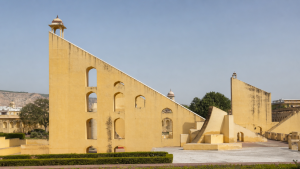
- Jantar Mantar: Maharaja Sawai Jai Singh II of Jaipur constructed five astronomical observatories in northern India during the early 18th century.
- Observatory Locations: These brick-and-stone observatories are located in New Delhi, Jaipur, Ujjain, Varanasi, and Mathura. The Jaipur observatory contains the Samrat Yantra, the largest stone sundial in the world.
- Purpose: These structures were designed to compile astronomical tables, predict the movements of the Sun, Moon, and planets, and refine local calendars.
Recent Context
The All India Institute of Ayurveda launched AyurVarta to discuss Ayurveda and contemporary health applications. The shift of Ayurveda Day to 23 September aligns it with the autumnal equinox and a fixed global date.
Rare Facts for Prelims
- Equinox link: 23 September is associated with the autumnal equinox, when day and night are nearly equal.
- Solstice reference: Ancient Indian texts also used solstices to mark key seasonal and ritual transitions.
- Fixed and movable karanas: Of the 11 karanas, only four are fixed; the rest repeat in a cycle.
- National Calendar base: The Indian National Calendar begins from the Saka era, not the Vikram era.
- Largest sundial: The Samrat Yantra at Jaipur is designed with remarkable precision for shadow-based time measurement.
- Adhika Masa purpose: The extra lunar month prevents festivals from drifting away from their seasonal positions.
| Related | |
|---|---|