Important UN Missions in Africa
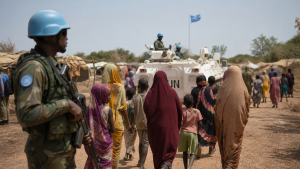
The United Nations has deployed some of its largest and most complex peacekeeping missions in Africa. These missions, authorized by the UN Security Council, have evolved from ceasefire monitoring to civilian protection, humanitarian support, and state rebuilding.
Active UN Peacekeeping Missions in Africa
There are currently five active UN peacekeeping missions operating on the African continent.
MINURSO (Western Sahara)
- Establishment: April 1991, under UN Security Council Resolution 690.
- Location: Western Sahara.
- Objective: Monitor the ceasefire between Morocco and the Polisario Front.
- Key Tasks: Organize and conduct a free referendum on independence or integration with Morocco.
- Key Fact: It remains one of the longest-running UN missions in the world.
MONUSCO (Democratic Republic of the Congo)
- Establishment: July 2010, succeeding MONUC, which began in 1999.
- Location: Democratic Republic of the Congo (DRC).
- Objective: Protect civilians, stabilize state institutions, and support the demobilization of armed groups.
- Key Tasks: Neutralize armed groups in eastern DRC, including M23 and FDLR.
- Key Fact: It has had one of the largest budgets and military deployments of any UN peacekeeping operation. Its Force Intervention Brigade (FIB) has an offensive mandate.
UNMISS (South Sudan)
- Establishment: July 2011, under UN Security Council Resolution 1996.
- Location: South Sudan.
- Objective: Prevent civil conflict, protect civilians, monitor human rights abuses, and support peace agreements.
- Key Tasks: Provide protection to internally displaced persons (IDPs) through Protection of Civilians (PoC) sites.
- Key Fact: It was created immediately after South Sudan’s independence and deals with major displacement crises.
MINUSCA (Central African Republic)
- Establishment: April 2014, under UN Security Council Resolution 2149.
- Location: Central African Republic (CAR).
- Objective: Protect civilians, support the peace process, secure humanitarian aid, and assist disarmament.
- Key Tasks: Maintain security amid clashes between Anti-balaka and Séléka groups.
- Key Fact: It replaced the African Union-led MISCA force to provide a broader international response.
UNISFA (Abyei)
- Establishment: June 2011, under UN Security Council Resolution 1990.
- Location: Abyei Area, a disputed border region between Sudan and South Sudan.
- Objective: Monitor demilitarization, protect civilians, and facilitate humanitarian access.
- Key Tasks: Prevent clashes between the Misseriya and Ngok Dinka communities.
- Key Fact: It was initially composed almost entirely of Ethiopian troops.
Major Past UN Peacekeeping Missions in Africa
Several historic missions shaped the political and security landscape of African states.
ONUC (Republic of the Congo)
- Duration: July 1960 – June 1964.
- Context: Deployed after Congo’s independence amid law-and-order collapse and Katanga’s secession.
- Mandate: Ensure withdrawal of Belgian forces, maintain order, and preserve territorial integrity.
- Key Fact: It was the first UN peacekeeping mission in Africa. UN Secretary-General Dag Hammarskjöld died in a plane crash in Northern Rhodesia (now Zambia) in 1961 while trying to negotiate a ceasefire.
UNAMIR (Rwanda)
- Duration: October 1993 – March 1996.
- Context: Established to help implement the Arusha Peace Agreement.
- Outcome: It failed to prevent the 1994 Rwandan Genocide, in which about 800,000 people were killed.
- Key Fact: Its failure led to major changes in UN civilian protection mandates.
UNOSOM I and II (Somalia)
- Duration: April 1992 – March 1995.
- Context: Deployed during the Somali Civil War to monitor ceasefires and protect humanitarian aid amid famine.
- Outcome: UNOSOM II had a Chapter VII mandate, leading to clashes with militias. After the Battle of Mogadishu in October 1993, the US and UN withdrew forces.
UNAMSIL (Sierra Leone)
- Duration: October 1999 – December 2005.
- Context: Deployed to implement the Lomé Peace Agreement after a decade-long civil war.
- Outcome: It disarmed more than 75,000 ex-combatants, rebuilt security forces, and supported democratic elections.
- Key Fact: It is widely regarded as one of the most successful UN missions in Africa.
UNMIL (Liberia)
- Duration: September 2003 – March 2018.
- Context: Established after the Second Liberian Civil War and the removal of President Charles Taylor.
- Outcome: It disarmed over 100,000 combatants, secured borders, oversaw elections, and assisted during the 2014 Ebola outbreak.
UNAMID (Darfur, Sudan)
- Duration: July 2007 – December 2020.
- Context: Deployed to address the conflict in Darfur.
- Outcome: It was the first hybrid peacekeeping mission jointly run by the UN and the African Union.
- Key Fact: Its main focus was civilian protection and humanitarian access.
MINUSMA (Mali)
- Duration: April 2013 – December 2023.
- Context: Established after the 2012 Tuareg rebellion and the takeover of northern Mali by Islamist extremist groups.
- Outcome: It faced frequent attacks and withdrew completely in December 2023 after a formal request from Mali’s military government.
UNMEE (Ethiopia and Eritrea)
- Duration: July 2000 – July 2008.
- Context: Deployed to monitor the ceasefire after the border war between Ethiopia and Eritrea.
- Outcome: It was terminated due to severe restrictions imposed by Eritrea on movement and fuel supplies.
UNOCI (Côte d’Ivoire)
- Duration: April 2004 – June 2017.
- Context: Established to support the peace agreement between the government and rebel forces.
- Outcome: It supported the 2010 presidential election and helped restore state authority before withdrawal in 2017.
Summary of Key UN Missions in Africa
| Acronym | Country/Region | Operational Years | Primary Focus/Outcome |
| ONUC | Republic of the Congo | 1960 – 1964 | First African UN mission; addressed Katanga secession. |
| UNAMIR | Rwanda | 1993 – 1996 | Failed to prevent the 1994 genocide due to lack of resources and mandate. |
| UNOSOM II | Somalia | 1993 – 1995 | Focused on humanitarian aid; faced severe urban combat in Mogadishu. |
| UNAMSIL | Sierra Leone | 1999 – 2005 | Highly successful disarmament and election support mission. |
| UNMEE | Ethiopia & Eritrea | 2000 – 2008 | Monitored border ceasefire; ended due to host country restrictions. |
| UNMIL | Liberia | 2003 – 2018 | Disarmed combatants and supported democratic transition. |
| UNOCI | Côte d’Ivoire | 2004 – 2017 | Facilitated post-civil war peace agreement and 2010 election. |
| UNAMID | Darfur (Sudan) | 2007 – 2020 | First hybrid AU-UN mission; protected Darfur civilians. |
| MONUSCO | DR Congo | 2010 – Present | Employs offensive Force Intervention Brigade (FIB). |
| UNMISS | South Sudan | 2011 – Present | Created Protection of Civilians (PoC) sites to house IDPs. |
| UNISFA | Abyei (Sudan/South Sudan) | 2011 – Present | Monitors demilitarized border; initially composed of Ethiopian troops. |
| MINUSMA | Mali | 2013 – 2023 | Withdrew in late 2023 at the host nation’s request. |
| MINUSCA | Central African Republic | 2014 – Present | Stabilizes conflict between Séléka and Anti-balaka groups. |
Key Peacekeeping Concepts and Trivia
These concepts are important for understanding UN operations in Africa.
Chapter VI vs. Chapter VII Mandates
- Chapter VI (Pacific Settlement of Disputes): Focuses on peaceful conflict resolution. Peacekeepers may use force only in self-defense.
- Chapter VII (Action with Respect to Threats to the Peace): Allows the Security Council to authorize military force to restore peace and security. Many modern African missions, such as MONUSCO and MINUSCA, operate under this framework.
The Capstone Doctrine
- Core Principles: Formulated in 2008, it identifies three basic principles of UN peacekeeping.
- Principles: Consent of the parties, impartiality, and non-use of force except in self-defense and defense of the mandate.
India’s Contribution to UN Missions in Africa
- Historical Involvement: India has been one of the largest troop and police contributors to UN missions in Africa.
- Key Deployments: Indian peacekeepers played a major role in ONUC (Congo) in 1960. Captain Gurbachan Singh Salaria was posthumously awarded the Param Vir Chakra for bravery in Katanga.
- Current Presence: India continues to deploy troops and medical personnel to MONUSCO and UNMISS.
- All-Female Units: India deployed the first all-female police unit to a UN peacekeeping mission in Liberia (UNMIL) in 2007.
Important: UN peacekeeping missions are authorized by the UN Security Council and are central to civilian protection and humanitarian access in conflict zones.
Recent Context
In August 2026, Indian peacekeepers in UNMISS and UNISFA received UN medals in South Sudan and Abyei for distinguished service. India remains among the top uniformed personnel contributors to UN peacekeeping worldwide.
Rare Facts for Prelims
- First UN peacekeeping deployment: UN peacekeeping began in 1948 with military observers in the Middle East.
- First African mission: ONUC was the first UN peacekeeping mission in Africa.
- Longest-running mission: MINURSO is among the longest-running UN missions globally.
- Hybrid mission: UNAMID was the first joint UN-AU peacekeeping mission.
- PoC sites: UNMISS’s Protection of Civilians sites became a major model for sheltering IDPs during conflict.
- Indian sacrifice: India has lost 177 peacekeepers under the UN flag, the highest among troop-contributing countries.
| Related | |
|---|---|