Districts As Export Hubs
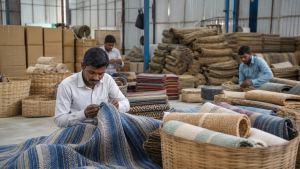
The Districts As Export Hubs (DEH) initiative is a decentralized trade promotion framework that aims to turn every district in India into an export-oriented centre by identifying local products and services with global demand.
Introduction to the Districts As Export Hubs Initiative
Implemented by the Directorate General of Foreign Trade (DGFT) under the Department of Commerce, Ministry of Commerce and Industry, the initiative seeks to connect local producers, farmers, and Micro, Small and Medium Enterprises (MSMEs) with international markets. It aligns with the Foreign Trade Policy 2023, Atmanirbhar Bharat, and the Vocal for Local campaign.
Shift from Concentration to Inclusive Trade
India’s export growth has traditionally been concentrated in a limited number of districts. Around 70 developed districts account for nearly 80 percent of the country’s merchandise exports.
The DEH initiative addresses this imbalance by spreading export-related opportunities to rural and remote regions. By early 2026, it had expanded to more than 770 districts across the country. It functions as a convergence platform rather than a separate funding scheme, coordinating existing central and state programmes to improve local competitiveness and remove infrastructure bottlenecks.
Convergence with the One District One Product Scheme
The One District One Product (ODOP) scheme has been operationally merged with DEH to streamline governance.
ODOP was originally designed to identify, brand and promote one distinct product from each district for balanced regional development. DEH expands this approach by covering the entire trade ecosystem, including supply chain infrastructure, credit access, quality standards and international buyer-seller meets.
Three-Tier Institutional Structure
The DEH initiative is implemented through a three-tier coordination system.
Central Level
- Department of Commerce: Provides overall policy direction and monitors implementation.
- DGFT Regional Authorities: Assist district administrations and track progress.
- Monitoring Portal: DGFT maintains an online portal where District Export Action Plans (DEAPs) are recorded and evaluated.
State Level
- State Export Promotion Committee (SEPC): Headed by the Chief Secretary of the state.
- Administrative Coordination: Promotes coordination among departments such as agriculture, MSME and textiles.
- Infrastructure Planning: Resolves policy conflicts and coordinates state-level infrastructure investment.
District Level
- District Export Promotion Committee (DEPC): Chaired by the District Magistrate or District Collector.
- Co-chair: The jurisdictional DGFT Regional Authority serves as co-chair.
- Role: Drafts and executes the District Export Action Plan (DEAP) at the ground level.
Key Components of District Export Action Plans
Each district prepares a customized District Export Action Plan (DEAP) based on its export potential and local needs.
- Product Mapping: Identifies products and services with export potential, such as craft clusters, agricultural produce and Geographical Indication (GI) tagged goods.
- Bottleneck Identification: Locates issues like lack of cold storages, testing laboratories or road connectivity to ports.
- Capacity Building: Provides training on export documentation, phytosanitary standards and quality certification.
- Financial Linkages: Connects local businesses with banks for low-interest trade credit.
- Market Access: Helps create online profiles and integrate businesses with e-commerce platforms.
Export Products Identified Under the Initiative
| State | District | Identified Product or Craft |
| Chhattisgarh | Bastar | Bastar Iron Craft |
| Maharashtra | Jalgaon | Bananas |
| Meghalaya | West Garo Hills | Mandarin Oranges |
| Tamil Nadu | Kanchipuram | Handloom Silk Sarees |
| Uttar Pradesh | Moradabad | Metal Crafts |
| Andhra Pradesh | Visakhapatnam | Araku Valley Coffee |
| Jammu & Kashmir | Budgam | Kani Shawls |
| Gujarat | Anand | Dairy Products |
Key Focus Areas for Enhancing District Exports
To support India’s target of USD 1 trillion in merchandise exports, the initiative focuses on the following areas:
Infrastructure and Logistics Support
- Upgrading sorting, grading and packaging facilities helps protect perishable goods.
- Developing inland container depots (ICDs) and local customs clearance facilities reduces transit time.
Financial Inclusion
- The government encourages collaboration with institutions like the Small Industries Development Bank of India (SIDBI) and the National Bank for Agriculture and Rural Development (NABARD).
- These institutions provide specialised financial schemes and credit facilities to small exporters.
E-Commerce Integration
- The Department of Commerce works with global e-commerce portals to list rural manufacturers.
- This helps tier-II and tier-III manufacturers reach international buyers without depending heavily on middlemen.
Quality Standards and Certifications
- Exporters receive support under the Zero Defect Zero Effect (ZED) scheme for quality and environmental certifications.
- Agricultural districts are helped in setting up laboratories to test pesticide residues and meet import norms.
Rare Facts for Prelims
- DGFT: The Directorate General of Foreign Trade is the chief authority for trade facilitation under the Foreign Trade Policy.
- DEAP: District Export Action Plans are district-specific roadmaps, not uniform national templates.
- SEPC: The State Export Promotion Committee is headed by the Chief Secretary, which gives it high-level administrative weight.
- GI-tagged goods: These are products whose quality or reputation is linked to a specific geographic origin.
- ICDs: Inland Container Depots act as dry ports and help in cargo handling away from seaports.
- ZED scheme: Zero Defect Zero Effect promotes manufacturing with minimal defects and reduced environmental impact.
| Related | |
|---|---|