Google Launches TPU 8tx and TPU 8i Max
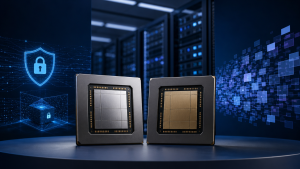
On 9 November 2026, Google expanded its eighth-generation Tensor Processing Unit (TPU) portfolio with TPU 8tx and TPU 8i Max. The new systems complement TPU 8t, designed for large-scale model training, and TPU 8i, optimised for inference and real-time reasoning. Google introduced four TPU systems in one year for the first time.
Different workloads and security
TPU 8tx targets secure, confidential inference and small-scale training. It uses hardware-level security to protect data and AI models during processing, and uses the same silicon as TPU 8t. The system is paired with fifth-generation AMD EPYC CPU hosts.
TPU 8i Max is designed for memory-intensive workloads, including large context windows and AI agents processing extensive codebases or lengthy videos. Google says it provides twice the computing capacity and memory bandwidth of TPU 8i.
Software and customer access
Google open-sourced TorchTPU in October 2026, enabling PyTorch code and Hugging Face models to run natively on its chips. An open-source TPU agent suite in preview supports Claude Code, Cursor and Google Antigravity, automating onboarding and custom-kernel optimisation. Customers can access TPUs through Google Cloud or deploy them in their own data centres. The business serves nearly 100 customers, including AI laboratories, trading firms, retailers and universities.
Important Facts for Exams
- Chip type: Google’s TPU is an application-specific integrated circuit, a neural-processing unit developed for neural-network machine learning.
- Compute profile: Compared with GPUs, TPUs favour high-volume, low-precision computation and more input/output operations per joule, without graphics-rendering hardware.
- Systolic-array design: Google selected the TPU’s systolic-array design after three separate groups developed AI accelerators.
- Precision evolution: The second-generation TPU added floating-point computation to integer processing and introduced bfloat16, enabling both training and inference.
| Related | |
|---|---|