China Restricts Exports of Tunnel Boring Machines
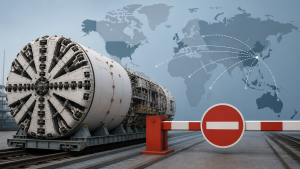
China’s Ministry of Commerce (MOFCOM) and General Administration of Customs announced new export controls on Tunnel Boring Machines (TBMs) and related equipment on 19 October 2026. The controls take effect on 18 November 2026 and cover specified machinery, parts and remanufacturing technologies.
Export Control Framework
The controls apply to full-face TBMs, specially designed TBM parts, specified walking excavators and plateau-type wet shotcrete machines designed for use at altitudes above 3,000 metres. Related remanufacturing technologies are also covered. Exporters must obtain licences from MOFCOM under China’s export control laws and regulations concerning dual-use items. Dual-use items are goods, software or technologies that can have civilian uses and may also be applied to military or security-related purposes. Exports to “sensitive countries and regions” involved in disputes with China require approval from Chinese trade authorities. Exports to other destinations are subject to registration and reporting procedures, including pledges that the products will not be diverted to sensitive areas. The controls are intended to safeguard national security and interests.
Tunnel Boring Machines and Related Equipment
A TBM is a machine used to excavate tunnels through soil or rock. Full-face TBMs excavate the tunnel cross-section across its full diameter, while specially designed components can be subject to export controls alongside the machines. Walking excavators are designed to move across uneven or difficult terrain. Wet shotcrete machines spray concrete onto surfaces, including tunnel walls; the specified machines in China’s controls are designed for high-altitude use above 3,000 metres.
Market and Infrastructure Context
Chinese manufacturers account for nearly 70% of the global TBM market. China exported about US$793 million worth of tunnelling machinery in 2025. India is a major importer of TBMs and has faced delays in importing the machines from China since 2024. Infrastructure projects cited in connection with these delays include metro systems and the Mumbai-Ahmedabad High-Speed Rail Corridor. In 2024 and 2025, German companies manufacturing TBMs in China were also reported to have faced restrictions on exports to India, which were attributed to political reasons.
Important Facts for Exams
:
- MOFCOM is China’s Ministry of Commerce.
- China’s new export controls take effect on 18 November 2026.
- The controls include plateau-type wet shotcrete machines designed for altitudes above 3,000 metres.
- TBMs are used to excavate tunnels through soil or rock.
The new controls cover specified machinery, components and related remanufacturing technologies. Exporters require a MOFCOM licence for controlled items.
| Related | |
|---|---|