The Delimitation Bill, 2026: 850-Seat Ceiling, Delimitation and Women’s Reservation
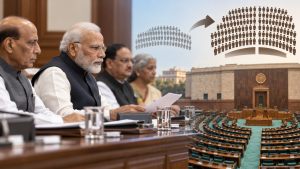
The Constitution (132nd Amendment) Bill, 2026 proposes to raise the Lok Sabha’s constitutional ceiling to 850 seats, increase each state and Union Territory’s allocation at the first delimitation, and bring women’s reservation into effect after that exercise. The text of Bill No. 158 is marked for introduction in the Lok Sabha. It is not law and does not set 2029 as a statutory deadline.
Lok Sabha and assembly seats
The Lok Sabha currently has 543 elected seats. Article 81 allows up to 550, with 530 from states and 20 from Union Territories. The bill raises these ceilings to 815 and 35, respectively. Under Article 170, the ceiling for a state assembly would rise from 500 to 650.
The first delimitation after the amendment takes effect would increase by 50 per cent both the Lok Sabha seats allocated to each state and Union Territory and the total seats in each state or Union Territory assembly that exists. The increase is based on the seats in place immediately before that delimitation. The 850 figure is a ceiling, not an allotment of 850 constituencies.
Which population figures would be used?
Seat allocation determines how many representatives a state has. Delimitation draws the constituency boundaries within it. Article 81 seeks a broadly uniform population-to-seat ratio across states, except for states with a population of 60 lakh or less, and a separately balanced ratio within each state as far as practicable.
The 42nd Amendment froze seat readjustment on the basis of later censuses. The 84th Amendment continued the freeze on seat allocation based on the 1971 Census until publication of the relevant figures of the first census taken after 2026. It allowed boundaries to be redrawn without changing state allocations. The 87th Amendment shifted that boundary exercise to the 2001 Census, which underpinned the 2008 Delimitation Order.
The new bill would carry specified arrangements under Articles 81, 82 and 170 forward to 2051. It would base the initial seat increase on the new Article 334A formula, rather than allocate the extra seats in proportion to each state’s latest population. Within-state boundaries would use the latest published census figures available when the amendment commences. That would mean the 2011 Census if no more recent figures had been published by then. A uniform seat increase would broadly preserve the balance among states, but would not itself correct existing disparities in population represented per MP.
Women’s reservation and SC/ST representation
The 106th Amendment, in force from 16 April 2026, provides for roughly one-third reservation for women, including within seats reserved for Scheduled Castes and Scheduled Tribes where applicable. The current Article 334A ties implementation to delimitation after publication of the relevant figures of the first census taken after that amendment commenced.
The proposed Article 334A instead activates the quota after the first delimitation following commencement of the 132nd Amendment. It covers the Lok Sabha, state assemblies and the assemblies of Delhi, Puducherry and Jammu and Kashmir. The new arrangements would not affect sitting Houses and assemblies before their dissolution. Rotation would be decided under a law made by Parliament, and the 15-year period would run from 16 April 2026, unless Parliament extends it by law.
Article 330’s population reference for SC and ST seat reservations, which also applies to Article 332, would use the same latest published census figures available at commencement until 2051. The bill also continues the special ST arrangements in the assemblies of Arunachal Pradesh, Meghalaya, Mizoram, Nagaland and Tripura until a readjustment takes effect after 2051.
Presidential elections
The change to Article 54 would include Jammu and Kashmir alongside Delhi and Puducherry in the definition of a state for Articles 54 and 55, bringing its elected MLAs into the presidential electoral college. The change to Article 55 would retain the 1971 Census population reference for calculating the value of votes until 2051.
The April bill and the companion delimitation bill
The earlier Constitution (131st Amendment) Bill, introduced in April 2026, also proposed an 850-seat ceiling but would have allowed Parliament to choose a published census by law. It did not secure the required special majority in the Lok Sabha on 17 April. Two ordinary bills introduced alongside it, the Delimitation Bill and the Union Territories Laws (Amendment) Bill, were not proceeded with after introduction. The government has given notice of its intention to withdraw the pending April Delimitation Bill and replace it with the Delimitation (Second) Bill, 2026.
The government’s statement describes the replacement as providing for a Delimitation Commission soon after commencement, use of the latest census figures published by the commencement of that legislation for drawing boundaries, and rotation of seats reserved for women as the Commission determines. The Commission would also readjust Lok Sabha allocations and assembly strength under the proposed law. The statement explains the companion bill, but does not itself withdraw the April bill or put the replacement into effect.
What happens next?
Article 368 requires a majority of the total membership and at least two-thirds of members present and voting in each House. Because the proposal changes the representation of states in Parliament, it also requires ratification by at least half of the state legislatures before presidential assent. If enacted, the amendment would commence on a date notified in the Official Gazette. Until those steps take place, the present constitutional rules remain in force.
| Related | |
|---|---|