Astronomers Detect Radio Signals from Beta Pictoris b
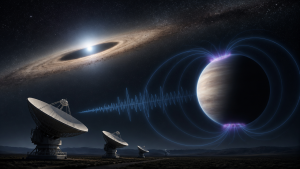
Scientists announced the first direct detection of radio signals from an exoplanet on 23 September 2026. The signals came from Beta Pictoris b, a gas giant about 63 to 64 light-years from Earth, and were detected with South Africa’s MeerKAT radio telescope array.
Exoplanets and Radio Astronomy
An exoplanet is a planet that orbits a star outside the Solar System. Radio astronomy studies celestial objects by detecting radio waves, which are a form of electromagnetic radiation with wavelengths longer than visible light.
Beta Pictoris System
Beta Pictoris b orbits the young star Beta Pictoris, which is located in the constellation Pictor. The planet is a massive gas giant and is known for its rapid rotation, completing one full rotation in about eight to nine hours.
Magnetic Fields and Auroral Emissions
The detected radio emissions are linked to powerful auroras on Beta Pictoris b. Auroras are produced when charged particles interact with a planet’s magnetic field, and the radio bursts showed strong circular polarisation, a feature associated with magnetic radiation.
Important Facts for Exams
- Beta Pictoris b is one of the best-studied exoplanets in the Beta Pictoris system.
- MeerKAT is a radio telescope array in South Africa and is operated as part of the Square Kilometre Array pathfinder programme.
- Circular polarisation is a property of electromagnetic waves in which the electric field rotates in a circular pattern.
- Jupiter is the Solar System planet best known for strong auroral radio emissions.
Scientific Method Used
Researchers compared radio images with the precise positions of distant quasars to confirm that the signal originated from Beta Pictoris b and not from its host star. The findings provide the first direct measurement of an exoplanet’s magnetic field and place it at least 1,250 times stronger than Earth’s.
| Related | |
|---|---|