Ten captive-bred Great Indian Bustards to be released in Jaisalmer
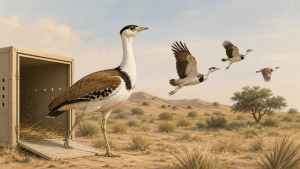
Ten captive-bred Great Indian Bustards (Ardeotis nigriceps) are scheduled for release in Jaisalmer district of Rajasthan on 3 and 4 October 2026. The release is planned at Ramdevra and Sudasari in the Desert National Park, and the birds will be monitored after release for movement, behaviour, habitat use, adaptation, and survival.
Great Indian Bustard
The Great Indian Bustard is one of the heaviest flying birds in the world and is a grassland species of the Indian subcontinent. It is listed as Critically Endangered on the IUCN Red List and is protected under the Wildlife (Protection) Act, 1972 in India.
Conservation breeding and rewilding
The birds were bred at a conservation breeding facility and trained in a specially designed tunnel before release. Rewilding training is used to reduce human dependence and to prepare captive-bred birds for conditions in open habitat. The initiative is being carried out under the supervision of the Wildlife Institute of India. A final technical assessment by WII scientists will decide the exact number of birds that will enter open habitat directly.
Project background in Rajasthan
The Integrated Great Indian Bustard Conservation Project was launched in 2016. A large-scale conservation breeding programme in Rajasthan began in 2019, and the first captive-bred chick at the modern centre at Ramdevra was born in March 2023. The species’ conservation in the Thar Desert is linked with grassland habitat protection in western Rajasthan. The Desert National Park in Jaisalmer is one of the key habitats associated with the species in India.
Important Facts for Exams
- The Great Indian Bustard is the state bird of Rajasthan.
- The species is found mainly in arid and semi-arid grasslands of India and Pakistan.
- The Desert National Park lies in the Thar Desert region of Rajasthan.
- The Wildlife Institute of India is a premier research institution under the Ministry of Environment, Forest and Climate Change.
Release sites in Jaisalmer
Ramdevra and Sudasari are the two proposed release sites for the first phase of the programme. Senior officials and wildlife experts from India and abroad are expected to attend the release programme.
| Related | |
|---|---|