Ancient Solar Eclipse Record Refines Earth’s Rotation Estimates
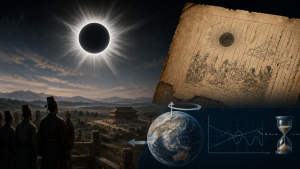
A total solar eclipse observed on 17 July 709 BCE at the court of the Lu Duchy in ancient China has provided new constraints on Earth’s historical rotation. Researchers corrected an approximately eight-kilometre error in the mapped location of ancient Qufu, enabling a more accurate reconstruction of the eclipse’s visibility. The study was published in Astrophysical Journal Letters.
Historical eclipse records
The eclipse was recorded in the Spring and Autumn Annals, a chronicle compiled around 200–300 years after the event. Its entry states that the Sun was totally eclipsed. The record is regarded as the earliest explicit written account of a total solar eclipse that can be securely dated.
A later passage in the Hanshu, or Book of Han, describes the eclipsed Sun as “completely yellow above and below”. The passage was written centuries after the eclipse and may preserve an early description of the solar corona, the Sun’s outer atmosphere visible during totality. That interpretation remains uncertain because the account is later than the observed event.
Earth’s rotation and delta T
Earth’s rotation rate varies over time. Delta T (ΔT) expresses the difference between time measured by Earth’s rotation and a uniform time scale. The revised reconstruction places ΔT for the 709 BCE eclipse between 20,264 and 21,204 seconds.
Earth’s long-term rotational slowdown is partly associated with oceanic tidal friction: the Moon’s gravity raises tides, and friction in the oceans transfers rotational energy. Earth therefore rotated slightly faster around 2,700 years ago than it does today. The updated coordinates also help refine calculations of the visibility and timing of historical astronomical events.
Solar activity and the corona
The possible corona description has also been considered in research on ancient solar activity. The Sun may have been entering a more active phase after an extended period of unusually low activity known as the Neo-Assyrian Grand Minimum or the Homer Grand Minimum. Solar activity can be investigated through historical observations and natural records, including radiocarbon measurements.
Important Facts for Exams
- A total solar eclipse occurs when the Moon completely covers the Sun’s disc from the observer’s viewpoint.
- The solar corona is the Sun’s outer atmosphere and is visible to the unaided eye during totality.
- Earth’s rotation is not perfectly constant, and ΔT is used to quantify its variation relative to a uniform time scale.
- The Spring and Autumn Annals and the Hanshu are historical Chinese texts containing accounts relevant to this eclipse.
The research team included Hisashi Hayakawa of Nagoya University and Mitsuru Sôma of the National Astronomical Observatory of Japan.
| Related | |
|---|---|