Siachen Glacier Dispute
Every year, many soldiers of India manning the Sonam and other posts of Siachen Glacier lose their lives due to avalanches and other such accidents. Each time, the critics argue that there is no need to safeguard such an inhospitable terrain under extreme weather conditions, at the height of 21,000 feet and call for demilitarization of the entire area. This backgrounder provides an insight into the Siachen Glacier Dispute.
Geography of Siachen Glacier
Also known as third pole, Siachen glacier is the longest glacier in the Karakorum and world’s second longest non-polar glacier {after Fedchenko Glacier in Tajikistan, which is world’s largest non-polar glacier, also note that Lambert-Fisher Glacier in Antarctica is world’s largest glacier} and also the world’s highest battlefield. It is largest single source of fresh water in the Indian subcontinent. It is located in the eastern Karakoram Range in the Himalaya Mountains. It is source of Nubra River that eventually feeds the mighty Indus. Siachen is near the Karakoram pass, forming almost a triangle with India, China and territory occupied by Pakistan touching the edges.
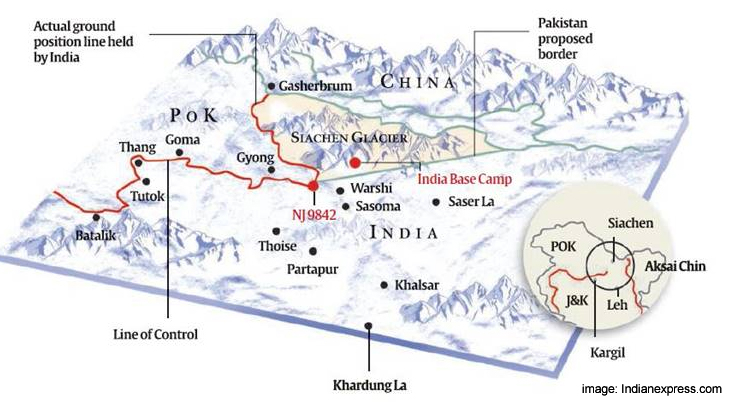
The glacier stretches for a length of around 76 kms and lies just northeast of the point NJ9842, where the Line of Control between India and Pakistan terminates. The glacier flows from an altitude of 5750 metres above sea level at its head at Indira Col on the china border to 3620 metres above sea level. Avalanches and landslides are very common in this area especially during the winter and temperatures can drop as low as minus 50°C. The entire Siachen glacier along with its tributaries covers an area of 700 sq.km. and is under the administrative control of India since 1984.
India Pakistan controversy
Most of India-Pakistan border remains delineated as the LOC or Line of Control with their respective troops on either side. Most of these positions were delineated as per the 1972 Shimla Agreement; however, the boundary line was specified to only a point known as NJ 9842. The Shimla agreement provided that after this NJ 9842, boundary would proceed “north to the glaciers“. However, the agreement did not specify which nation would have control over which area.
There was no controversy over the area until the early 1980s. In 1970s and 80s, Pakistan started to allow several mountain expeditions to Siachen glacier from its side. This was viewed by India as an attempt by the Pakistani government to lay claim on the Siachen glacier. From 1978, India also allowed mountaineering expeditions, the most notable being that of the Colonel Narinder Kumar’s expedition, whose inputs helped in making Operation Meghadoot successful.
Operation Meghdoot
In 1984, India got intelligence inputs that Pakistan is planning to occupy Siachen glacier. A reconnaissance mission was carried out and it found that foreign expeditions were being undertaken in the area. The major strategic point here is the Saltoro ridge. India launched Operation Meghadoot on 13 April 1984 and occupied strategic positions along the Saltoro ridge and since then the glacier is under the administrative control of India.
Thus, since 1984 the Siachen glacier area has been the venue of a continuing military standoff between India and Pakistan. It is the highest battleground in the world. Currently, the strategic points on the glacier are occupied by both sides, with India having a clear strategic advantage.
Indian Army’s base camp is located at a height of 12,000 feet. The Siachen glacier is claimed by both India and Pakistan. A ceasefire is in operation since November 2003, and since then there are no incidents of fire exchange between the troops with Indian troops stationed on the upper part of the glacier and Pakistani troops the lower part.
Stance of India and Pakistan
India says that the LoC runs from point NJ 9842 along the watersheds formed by the Saltoro ridge that puts the entire Siachen glacier within Indian Territory. However, Pakistan says that the line joins point NJ 9842 with the Karakoram pass that lies towards the northeast, putting Siachen within its territory.
Bilateral negotiations
The rounds of bilateral talks began from 1985. After more than a dozen rounds, both sides have agreed that the Siachen glacier should be demilitarised, but they have not agreed on how the troops will be withdrawn. India says that both the nations should jointly demarcate the current troop positions in the Siachen area. This may be an exhaustive process to determine and delineate current troop’s positions both on the ground and on a map. After this demarcation, India believes, troops can be moved back to pre-1984 positions and the border issue can be solved with dialogue. However, Pakistan is strongly against a demarcation of troop positions. Pakistan says that any joint demarcation or authentication of troops positions can be used as a claim by India for future talks to resolve the matter. Pakistan insists on a mutual withdrawal of troops to pre- 1984 deployments for talks to begin. This is the standoff between India and Pakistan on Siachen Glacier.
After the 1999 Kargil conflict in which insurgents supported by the Pakistani Army occupied critical locations along the LoC, India has further hardened its stand for authentication of troops positions. India wants a demarcation so that in future, it can take military action, if Pakistan deceptively occupies troops positions even after vacating these as per the demilitarisation plan.
Indian Army is very strict on the point of authentication of troop positions. India says that demarcation will not take anything away from Pakistan because the current troop positions are a hard, cold fact. Marking the positions on a map, will facilitate a comfortable withdrawal of troops from both sides. Pakistan believes that India has illegally occupied the glacier and cannot be authenticated jointly by both sides.
Other solutions
There have been several off the track solutions of the Siachen dispute. Some of them include declaring the area a peace park, joint patrolling of the region and even an international peacekeeping force being deployed.
Current Status
At present, Indian Army controls the entire Saltoro ridge. There is no presence of Pakistani troops on the Siachen glacier. Moreover, the nearest Pakistani locations are on the lower reaches of the Saltoro ridge. Since India managed to get the upper hand, it currently controls all heights along the glacier on the Saltoro ridge and uses the glacier as a logistics base. Since 2007, India has also been promoting treks and expeditions by civilians and foreigners in the vicinity of the glacier to reaffirm its claim on the region. Indian Army gives permission to mountaineers to climb peaks in the Eastern Karakoram adjoining the glacier. The Army also holds a civilian Siachen expedition every year and will in the future invite even foreigners to trek up the glacier.
Difficulties for India
Siachen glacier offers an inhospitable terrain marked by extremes of temperature and has no mercy for the soldiers stationed there. Most soldiers die here owing to climatic conditions and environmental factors rather than of the battle wounds.
Recent example is the death of 10 soldiers of the Madras regiment. With increase in global warming, it is feared that the soldiers posted in Siachen are more vulnerable to natural disasters. According to government estimates, 869 Indian troops have died at the Siachen glacier between 1984 and December 2015. In 2012, 129 soldiers of the Pakistan military and 11 civilians perished after a massive avalanche struck them.
Expenses incurred by the government
Manning Siachen glacier has become one of the costliest affairs for Indian and Pakistani armies both in terms of economy and man power. As per Indian government figures, India has invested over Rs 7,500 crore for procurement of high quality equipments and clothing for soldiers posted in high-altitude areas. It is estimated that on an average, India spends Rs. 5 crore a day for manning Siachen glacier.
With India being home to the world’s largest poor people, is it justified to man Siachen glacier by gambling with the precious lives of the soldiers? This is a major question put forward by critics.
However, India categorically rejects any troop withdrawal from the Siachen glacier as it is not ready to trust Pakistan enough especially after the Kargil war. It rejected the idea and stated it can only do so with proper delineation, authentication, and acceptance of the current positions by the Pakistani side.
The Strategic Angle
Military experts and activists have consistently questioned the strategic significance of the Siachen glacier. The following are the reasons attributed for the strategic significance of the Siachen Glacier.
Firstly, Siachen is strategically located between Pakistan occupied Kashmir and China. Keeping hold on the glacier is important in the backdrop of construction of Karakoram Highway and coming up China Pakistan Economic corridor. There are security implications for the Nubra, Shyok and Ladakh regions.
Secondly, India presently occupies all the vital strategic heights on the Glacier and the withdrawal of troops to lower areas may prompt Pakistan to occupy them. To regain the vital commanding heights would be next to impossible after withdrawing from them.
Thirdly, India feels that Siachen is its territory and rightfully belongs to it. So, it becomes the duty of the armed forces to guard them. It is argued that the Indian Army also guards similar inhospitable terrains like Dras, Kargil etc. If troop withdrawal is necessary in Siachen due to the unfavourable terrain, then it may also be necessary in areas such as Dras and Kargil. But the events like Kargil war provide enough reason to station the troops in these regions.
Way forward
While every life is precious, the security of the nation cannot be compromised. Instead, new ways to address the problem should be found out. Modern technology such as remote sensing has to be extensively used to assist the soldiers, though it may not be possible at present to replace soldiers with technology. Present infrastructure to study weather patterns has to be upgraded and extensive climatic studies should be carried out in the region to forewarn the soldiers before the disaster strikes.
Demilitarisation of the region is doable as long as Pakistan agrees that it would not breach the peace clause and is ready to accept the present position. But that is unlikely to happen. As long as Pakistan sponsors terrorism, India cannot take risk of losing its vital assets.