Major Digital India Initiatives and Their Components
The Digital India Programme is a flagship government initiative to build a digitally empowered society and knowledge economy. It combines digital infrastructure, public service delivery, payments, identity systems, health platforms and data governance under one broad framework.
Digital Infrastructure and Connectivity
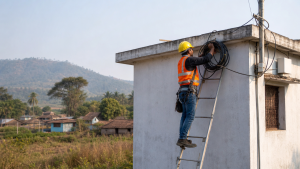
- BharatNet Project: Funded through the Digital Bharat Nidhi (DBN), which replaced the Universal Service Obligation Fund (USOF), this project provides rural broadband connectivity. As of June 2026, about 2.21 lakh Gram Panchayats were service-ready, with more than 42 lakh route kilometres of optical fibre cable laid.
- Amended BharatNet Program (ABP): Also known as Phase 3, this phase converts vulnerable linear networks into ring-based IP-MPLS (Internet Protocol-Multiprotocol Label Switching) architecture to improve reliability and reduce downtime. In March 2026, BSNL awarded an ₹8,025 crore contract to Pratap Technocrats for implementation in Rajasthan, Haryana and Assam.
- Rural Mobile Coverage: To address connectivity gaps in remote areas, the DBN-funded mobile scheme had commissioned 24,784 mobile towers across rural regions as of June 30, 2026.
- Electronics Manufacturing: Domestic electronics production expanded from ₹1.9 lakh crore in FY 2014-15 to about ₹12 lakh crore by March 2026, making India the world’s second-largest mobile phone manufacturer.
- Mobile Data Costs: Average mobile data prices declined sharply from ₹269 per GB in 2014 to about ₹8-10 per GB in FY 2025-26.
Identity, Payments and Document Services
- Aadhaar Platform: India’s biometric identification system has generated over 1.44 billion unique identity numbers as of mid-2026.
- Direct Benefit Transfer (DBT): Using Aadhaar-linked bank accounts, DBT has transferred over ₹52 lakh crore across 318 schemes under 56 ministries directly to beneficiaries as of mid-2026.
- Unified Payments Interface (UPI): Operated by the National Payments Corporation of India (NPCI), UPI connects 731 banks and serves 55.49 crore individuals and 6.5 crore merchants. It handles nearly 50% of global real-time digital payments as of mid-2026.
- DigiLocker: This paperless document system has crossed 71.66 crore registered users and stores over 936.03 crore digital documents from 2,822 onboarded issuing authorities as of mid-2026.
Digital Health and Digital Commerce
- Ayushman Bharat Digital Mission (ABDM): Administered by the National Health Authority (NHA), ABDM has enabled the creation of more than 94.87 crore Ayushman Bharat Health Accounts (ABHAs) as of July 20, 2026, linking over 100 crore digital health records.
- Health Registries under ABDM: The Health Facility Registry (HFR) has 5.36 lakh registered facilities, while the Healthcare Professionals Registry (HPR) has 10.09 lakh verified practitioners as of July 20, 2026.
- Open Network for Digital Commerce (ONDC): Initiated by the Department for Promotion of Industry and Internal Trade (DPIIT) as a Section 8 non-profit company, ONDC aims to democratise digital commerce. It has onboarded over 7 lakh sellers across 1,200+ cities and processes about 1 crore transactions monthly as of mid-2026.
Data Protection and AI Translation
- Digital Personal Data Protection (DPDP) Act, 2023: This law regulates the processing of digital personal data. Following the gazette notification of the DPDP Rules, 2025, on November 13, 2025, the Act became fully operational, with phased compliance extending to mid-May 2027.
- Data Protection Board of India (DPBI): The board was established upon notification of the DPDP Rules, 2025, in November 2025 to adjudicate grievances and enforce compliance.
- Digital India BHASHINI: This AI-powered translation platform supports 23 Indian languages. In February 2026, it migrated its platform and 3.5 billion files from global hyperscalers to domestic cloud platforms run by Yotta Data Services to support data sovereignty.
Key Prelims Takeaways
- Nodal authorities: MeitY administers Digital India; NHA manages ABDM; DPIIT initiated ONDC; NPCI operates UPI.
- Funding base: DBN is the statutory successor to USOF and funds BharatNet as well as rural mobile tower deployment.
- BharatNet focus: The programme expands rural broadband connectivity through optical fibre and service-ready Gram Panchayats.
- ABP Phase 3: The network shift from linear to ring-based IP-MPLS architecture is meant to strengthen resilience.
- DBT scale: Aadhaar-linked DBT transfers welfare funds directly across 318 schemes under 56 ministries.
- DPDP framework: The DPDP Rules, 2025 made the law operational and brought the Data Protection Board of India into function.
- BHASHINI development: The platform’s move to Indian cloud infrastructure is linked to domestic data sovereignty.
Current General Studies comprises current-affairs-based, General Studies-rich study material on policies, laws, institutions, economy, science, environment, governance, international relations, and other varied but important topics for UPSC and State PSC Prelims examinations.
Fortnightly PDF compilations: Available here
Originally written on
February 14, 2026
and last modified on
September 4, 2026.
| Related | |
|---|---|