Types of Missiles Used in Modern Warfare
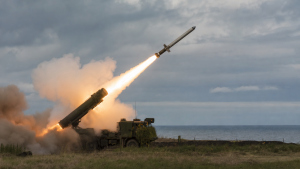
Missiles are guided, self-propelled weapons designed to deliver a warhead to a target. They are classified by trajectory, range, guidance and propulsion, launch platform, and intended target. These categories help explain their operational roles and their significance for defence preparedness, regional security and military modernisation.
Classification by Trajectory
The main trajectory-based categories are ballistic and cruise missiles. Their flight paths, propulsion and operating environments differ.
- Ballistic missiles: After an initial powered flight, they follow a trajectory primarily governed by gravity. They are generally launched on a high, often space-bound path and may re-enter the atmosphere before reaching the target. Their flight has boost, mid-course and terminal phases.
- Cruise missiles: These fly within the atmosphere, using aerodynamic lift and sustained propulsion to maintain flight. They are often described as uncrewed aircraft and can be guided towards fixed or moving targets. Their flatter, manoeuvrable paths can help them avoid detection.
- Operational distinction: Ballistic missiles are commonly associated with longer-range delivery, while cruise missiles are designed for controlled flight and precision strikes. Actual capabilities depend on the specific missile.
Classification by Range
Range is an important measure of a missile’s strategic utility. Thresholds can vary between references, so the categories below are commonly used guides rather than universal definitions.
- Short-Range Ballistic Missile (SRBM): Generally has a range below 1,000 kilometres.
- Medium-Range Ballistic Missile (MRBM): Generally covers 1,000 to 3,000 kilometres.
- Intermediate-Range Ballistic Missile (IRBM): Generally covers 3,000 to 5,500 kilometres.
- Intercontinental Ballistic Missile (ICBM): Has a range exceeding 5,500 kilometres.
- Cruise missiles: Short-range versions typically travel up to a few hundred kilometres; long-range versions can exceed 1,000 kilometres.
Guidance and Propulsion
Guidance directs a missile towards its target, while propulsion provides the thrust needed for flight. Together, these systems shape a missile’s reach, accuracy and ability to adjust its course.
- Inertial Navigation System (INS): Uses gyroscopes and accelerometers to estimate the missile’s position, velocity and orientation during flight.
- GPS guidance: Satellite positioning data can improve accuracy and correct drift in an inertial system.
- Terminal guidance: Sensors such as active radar, infrared, laser or optical systems can make final adjustments as the missile approaches its target.
- Avionics: Electronic systems that support functions such as navigation, guidance and control.
- Maneuverability: The capacity to alter a flight path, whether to refine the route to a target or respond to defences.
- Solid-propellant rockets: Offer simpler handling, reliable storage and faster launch preparation; they are widely used in ballistic missiles.
- Liquid-propellant rockets: Can provide higher thrust and be throttled, but require more complex fuelling procedures.
- Jet engines: Commonly power cruise missiles. A turbojet suits high-speed flight; a turbofan is more fuel-efficient, particularly at lower speeds.
- Ramjets and scramjets: A ramjet needs forward speed to compress incoming air and is efficient at supersonic speeds. A scramjet uses supersonic airflow for hypersonic flight.
Classification by Launch Mode and Target
These labels identify the platform from which a missile is launched and, in many cases, the target it is intended to engage.
- Surface-to-Surface Missile (SSM): Launched from a land or sea platform against a land or sea target.
- Surface-to-Air Missile (SAM): Launched from land or sea against airborne targets, including aircraft and other missiles; also known as an anti-aircraft missile.
- Air-to-Air Missile (AAM): Launched from an aircraft against another airborne target.
- Air-to-Surface Missile: Launched from an aircraft against a land or sea target. The abbreviation ASM is also used for anti-ship missile, so the intended meaning depends on context.
- Submarine-Launched Ballistic Missile (SLBM): A ballistic missile launched from a submarine; it contributes to a state’s second-strike capability.
- Anti-Tank Guided Missile (ATGM): Designed to engage armoured vehicles, often using a specialised warhead.
- Anti-ship missile: Designed to target surface vessels and may use a sea-skimming flight path.
Specialised Missiles and Defences
Some missile types are defined by their speed or defensive role rather than only by range or launch platform.
- Hypersonic missiles: Travel at speeds exceeding Mach 5. Hypersonic Glide Vehicles (HGVs) are rocket-launched to high altitude before gliding towards a target; Hypersonic Cruise Missiles (HCMs) use scramjet engines for sustained flight within the atmosphere.
- Interception challenge: The speed and manoeuvrability of hypersonic systems can make them difficult to intercept.
- Anti-Ballistic Missiles (ABMs): Designed to intercept incoming ballistic missiles and form part of missile-defence systems. Interception may occur in the terminal phase, as with Patriot, or outside the atmosphere, as with THAAD and GMD.
Key Prelims Takeaways
- Ballistic missiles follow a gravity-influenced trajectory after powered flight; cruise missiles sustain atmospheric flight using lift and propulsion.
- Common range guides place SRBMs below 1,000 km and ICBMs above 5,500 km; thresholds can vary.
- INS, GPS and terminal sensors are guidance tools; avionics support navigation, guidance and control.
- Solid propellant allows quicker launch preparation, while liquid propellant can provide higher, throttleable thrust.
- Hypersonic missiles travel above Mach 5; HGVs glide after rocket launch, while HCMs use scramjets.
- ABMs are defensive systems intended to intercept ballistic missiles.
Recent Context
On October 13, 2026, Pakistan test-launched an extended-range Fatah-II. The ISPR said it features advanced navigation and avionics; its stated range of up to 400 km places it in the commonly defined SRBM category. The test’s flight distance and accuracy results were not specified.
| Related | |
|---|---|