Ballistic Missile Range Classifications and Key Features
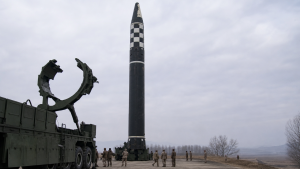
Ballistic missiles are classified chiefly by the maximum distance they can travel. Their powered flight is followed by an unpowered trajectory largely governed by gravity, making range and guidance key features for understanding their capabilities.
Understanding Ballistic Missiles
A ballistic missile is a rocket-propelled weapon designed to deliver a payload to a predetermined target. Unlike a cruise missile, which remains powered during flight and uses aerodynamic lift, a ballistic missile receives thrust mainly during its initial powered, or boost, phase. It then follows a trajectory governed chiefly by gravity and atmospheric drag. A missile’s range is its maximum operational distance. Classification thresholds are widely used, but definitions can vary between countries and organisations. Range alone does not describe a missile’s accuracy, payload or flight profile.
- Booster: Rocket stages provide the initial thrust. They may use solid or liquid propellants; solid propellants are valued for ruggedness and ease of storage and transport.
- Payload: The part that carries the warhead and associated systems. Warheads may be conventional, nuclear, chemical or biological.
- Guidance system: Electronic systems track the missile’s position, velocity and orientation and generate commands to correct its flight path.
- Re-entry vehicle: A protective structure that shields the warhead during its high-speed descent through the atmosphere.
Ballistic Missile Range Classifications
The commonly used categories below describe broad range bands. Tactical ballistic missiles are sometimes treated as a separate category and sometimes included within the short-range group. The reported range of Pakistan’s Fatah-II places it in the short-range category under common definitions.
- Tactical ballistic missiles (TBMs): Typically have a range of less than 300 kilometres. Some sources include them within the SRBM category.
- Short-range ballistic missiles (SRBMs): Commonly cover 300–1,000 kilometres. The Fatah-II has a reported range of up to 400 kilometres.
- Medium-range ballistic missiles (MRBMs): Commonly cover 1,000–3,500 kilometres; some definitions set the upper limit at 3,000 kilometres.
- Intermediate-range ballistic missiles (IRBMs): Commonly cover 3,500–5,500 kilometres. Some classifications instead use a lower boundary of 2,400 kilometres.
- Intercontinental ballistic missiles (ICBMs): Have ranges greater than 5,500 kilometres. Some can travel more than 10,000 kilometres, with reported ranges reaching up to 16,000 kilometres.
These bands are useful for comparing reach, but should not be treated as universally fixed boundaries. A missile’s classification by range does not, by itself, establish the distance covered in a particular test or indicate its accuracy.
Guidance and Avionics
Avionics refers to the electronic systems used for navigation, guidance and control. Guidance systems direct a missile towards its target, while manoeuvrability describes its capacity to alter its flight path. These features are relevant to assessments of accuracy and the ability to counter missile defences.
- Inertial navigation system (INS): Uses gyroscopes and accelerometers to track position, velocity and orientation without relying on an external reference after launch.
- Satellite guidance: May be integrated with INS to provide mid-course correction using signals from satellite constellations such as GPS or GLONASS.
- Terminal guidance: Some advanced missiles use guidance in the final phase of flight to adjust their path towards a target.
- Manoeuvrability: Advanced missiles may alter their flight path; this is described as a feature that can help them evade missile defence systems.
Missile Technology Control Regime
The Missile Technology Control Regime (MTCR) is a voluntary association of states established in 1987 to limit the proliferation of missiles and related technology capable of delivering weapons of mass destruction. Its guidelines cover equipment, software and technology in two control categories.
- Category I: Includes missiles capable of delivering a payload of at least 500 kilograms to a range of at least 300 kilometres, as well as major subsystems such as engines and re-entry vehicles.
- Production facilities: Transfers of facilities for producing Category I items are generally not authorised.
- Category II: Covers items considered less sensitive, including propulsion and launch components and missile systems with a range of at least 300 kilometres, irrespective of payload.
- Transfer decisions: Members have greater discretion over transfers of Category II items than over Category I items.
- Legal status: MTCR guidelines are an informal standard, not a legally binding international treaty. As of February 2023, the regime had 35 member states.
Strategic and Policy Significance
Range classifications help describe the reach of missile systems and support comparisons of their stated capabilities. They are relevant to defence policy and assessments of strategic stability and arms-race dynamics. Such assessments should distinguish between a missile’s reported maximum range and the distance or performance demonstrated in a specific test.
Key Prelims Takeaways
- Ballistic missiles are powered mainly during the initial boost phase; gravity largely governs their later trajectory.
- TBMs typically have ranges below 300 kilometres; SRBMs commonly cover 300–1,000 kilometres.
- MRBMs commonly cover 1,000–3,500 kilometres; IRBMs commonly cover 3,500–5,500 kilometres.
- ICBMs have ranges greater than 5,500 kilometres.
- INS uses gyroscopes and accelerometers; avionics covers electronic navigation, guidance and control systems.
- The MTCR is voluntary, and Category I includes missiles able to carry at least 500 kilograms to at least 300 kilometres.
Recent Context
Pakistan test-launched an extended-range version of the Fatah-II on October 13, 2026. The missile’s reported range is up to 400 kilometres; the specific distance and accuracy results of this test were not specified. ISPR described it as having advanced navigation and avionics.
| Related | |
|---|---|