Supreme Court: Commercial Forest Cultivation Not Protected by FRA
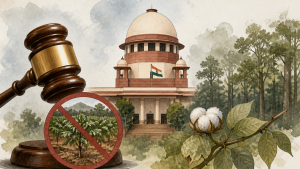
On 6 November 2026, the Supreme Court of India said commercial crop cultivation in reserve forests is not protected by the Forest Rights Act (FRA), 2006. Justices Vikram Nath and Sandeep Mehta made the observation while considering silk cotton cultivation in the reserve forests of the Agasthyamalai biosphere, particularly the Megamalai region of Tamil Nadu.
Court’s view on silk cotton cultivation
The Court took a prima facie view that planned or promoted cultivation of commercial crops is impermissible in forest areas. It distinguished such cultivation from the collection, use and disposal of naturally occurring minor forest produce recognised under Section 3(1)(c) of the FRA. The Court rejected Tamil Nadu’s claim that silk cotton cultivation was a historical practice qualifying as minor forest produce. About 3,637.83 hectares of 5,072.64 hectares of forest land in the region are under silk cotton cultivation.
The Central Empowered Committee (CEC) was directed to examine the State’s position on classifying silk cotton as minor forest produce. A Special Committee headed by former Chief Justice of India B.R. Gavai will supervise and scrutinise FRA claim adjudication in the region. The Court also said temporary residence in a forest, or residence entirely outside forest boundaries, does not by itself establish forest-dweller status through cultivation. Tamil Nadu was given 30 days to form any remaining Gram Sabhas and five months thereafter to decide all claims.
Important Facts for Exams
- Scheduled Tribe eligibility: FRA eligibility for a Forest Dwelling Scheduled Tribe requires Scheduled Tribe status in the claimed area, pre-13 December 2005 forest residence and forest-dependent livelihood.
- Traditional-dweller threshold: An Other Traditional Forest Dweller must show primary forest residence for three generations, or 75 years, before 13 December 2005, and livelihood dependence.
- Claim-verification sequence: The Gram Sabha first recommends which rights should be recognised; the resolution is then screened at subdivision level and approved at district level.
| Related | |
|---|---|