South Korea Launches CAS500-2 Earth-Observation Satellite
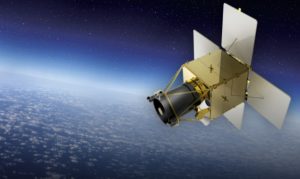
South Korea launched its domestically developed Earth-observation satellite Compact Advanced Satellite 500-2 (CAS500-2) into orbit on 3 May 2026. The satellite, also called Next-Generation Medium Satellite No. 2 or Cha Middle 2, lifted off aboard a SpaceX Falcon 9 rocket from Vandenberg Space Force Base in California, United States.
Launch Details
The launch took place at 3:59 p.m. Korea time, which was midnight local time in California. The Korea AeroSpace Administration (KASA) oversaw the mission. The launch came after a delay of nearly four years, and the original launch plan used a Russian Soyuz rocket before the Russia-Ukraine war changed the arrangement.
Orbit and Communication
About one hour after launch, CAS500-2 separated from the Falcon 9 rocket and entered a sun-synchronous orbit at an altitude of 498 kilometres. Fifteen minutes after separation, the satellite established its first communication link with a ground station in Svalbard, Norway, and confirmed normal operation.
Satellite Design and Mission
Korea Aerospace Industries (KAI) led the development and manufacturing of CAS500-2. It is the first Korean mid-sized Earth-observation satellite of its class built under private industry leadership. The satellite has a mass of 534 kilograms and carries high-resolution optical sensors for panchromatic imagery at 0.5-metre resolution and colour imagery at 2.0-metre resolution.
Important Facts for Exams
- Sun-synchronous orbit is a near-polar orbit used by Earth-observation satellites for consistent lighting conditions over the same area.
- Vandenberg Space Force Base in California is a major launch site for polar and sun-synchronous missions.
- Svalbard in Norway hosts ground stations used for satellite communication in polar-orbit missions.
- CAS500-2 is planned to complete about four months of on-orbit testing and calibration before its official mission begins in the second half of 2026.
Technology and Applications
CAS500-2 was developed with 86 percent of the satellite platform and 98 percent of the payload technology made domestically. Its official mission includes high-precision imagery for land and resource management, disaster response, and national spatial information services.
| Related | |
|---|---|