Scientists Identify Giant Prehistoric Fungus in China
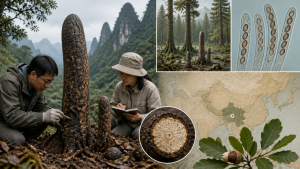
Scientists from China, Thailand and Mexico announced the discovery of Dianjunus rex, known as “D-rex”, in Yunnan Province, southwestern China, on 14 October 2026. The fungus produces upright fruiting structures that can reach 50 centimetres in height and weigh up to 2.2 kilograms. Its description was published in Frontiers in Fungal Biology on the same date.
Fungal fruiting structures
The vertical structures of D-rex are called stromata; a single structure is a stroma. Fungal fruiting bodies produce and release spores, which enable reproduction and dispersal. D-rex has the largest known fruiting structure recorded within Ascomycota, a fungal phylum containing more than 64,000 species. Ascomycota are commonly known as sac fungi because their sexual spores develop in microscopic sacs called asci.
Researchers hypothesise that the fungus’s unusual height may assist spore dispersal in dense forest environments. The structures grow from woody roots of Chinese cork oak trees.
Habitat and collection record
Specimens were collected in Yunnan between August 2024 and July 2025. The fungus was found in temperate coniferous forests and tropical rainforests, including sites near Damaidi, Yipinglang, Nanbang, Kunming and Lufeng. The findings place D-rex among fungi documented in the varied forest habitats of southwestern China.
Taxonomy and evolutionary history
The researchers established Dianjunus rex as a new species, Dianjunus as a new genus, and Dianjunaceae as a new family within the order Xylariales. Molecular clock analysis estimates that the Dianjunaceae lineage originated approximately 65 million years ago. This estimate places its origin shortly after the Cretaceous-Paleogene mass extinction, which occurred about 66 million years ago and brought the non-avian dinosaurs to extinction.
Important Facts for Exams
- Ascomycota is a fungal phylum whose sexual spores form in structures called asci.
- Xylariales is the order in which the family Dianjunaceae is classified.
- A stroma is a compact fungal structure that can bear spore-producing structures.
- The Cretaceous-Paleogene boundary dates to approximately 66 million years ago.
Dr Indunil C. Senanayake, an associate professor at the Germplasm Bank of Wild Species of the Kunming Institute of Botany, was a corresponding author of the study. D-rex is classified in the newly established family Dianjunaceae.
| Related | |
|---|---|