China Rejects EU Hybrid-Car Export Curbs
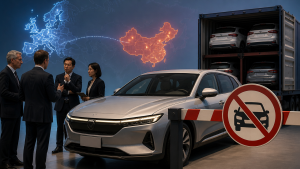
China rejected the European Commission’s request for voluntary limits on hybrid-car exports to the European Union during trade discussions that began in Beijing on 8 October 2026. EU Trade Commissioner Maroš Šefčovič and Chinese Commerce Minister Wang Wentao were scheduled to hold two days of negotiations on 8 and 9 October, including talks on the EU’s trade deficit with China.
EU-China Trade Discussions
The European Commission had proposed limiting Chinese hybrid-vehicle shipments to about 15% of the EU market; Chinese vehicles currently account for more than one-third of that market. The EU’s trade deficit with China exceeds €1 billion per day. Chinese carmakers held nearly 12% of Europe’s new-car market in August 2026 and accounted for about one in three plug-in hybrid sales in the region.
After China rejected the voluntary limit, the European Commission considered time-limited safeguard measures, including a tariff-rate quota. Under this arrangement, imports up to a specified volume may enter under one tariff rate, while imports above the threshold may face additional tariffs.
Hybrid Vehicles and Trade Measures
A hybrid vehicle combines an internal-combustion engine with an electric motor. A plug-in hybrid has a battery that can be recharged from an external electricity supply. The EU imposed anti-subsidy duties on Chinese electric vehicles in October 2024; hybrid cars did not face those duties at the time of the discussions.
The European Commission regards the hybrid-car issue as a test case for possible trade measures in other sectors with significant trade imbalances. The outcome of the negotiations may affect whether it proceeds with the proposed safeguards.
European Union Trade Policy Context
The EU’s common commercial policy covers trade relations with non-EU countries. Safeguard measures can restrict imports under specified conditions, while tariff-rate quotas combine an import-volume threshold with different tariff treatment above that threshold.
Important Facts for Exams
- The European Commission is the executive institution of the European Union.
- A tariff-rate quota sets a volume threshold for imports and applies a different tariff rate above that threshold.
- The European Council brings together the heads of state or government of EU member states and sets the Union’s general political direction.
- The European Council summit was scheduled for 15–16 October 2026 to discuss the trade talks’ outcome.
The EU’s anti-subsidy duties on Chinese electric vehicles took effect in October 2024, while hybrid cars were not subject to those duties in this dispute.
| Related | |
|---|---|