Nobel Prize in Medicine 2026 Awarded for Optogenetics
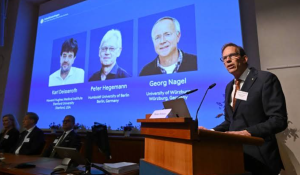
The Nobel Prize in Physiology or Medicine 2026 was awarded to Karl Deisseroth, Peter Hegemann and Georg Nagel on 5 October 2026. The Nobel Assembly at the Karolinska Institutet in Stockholm, Sweden, announced the prize for discoveries concerning light-gated ion channels and optogenetics.
Optogenetics
Optogenetics is a technique that uses light-sensitive proteins to control the activity of cells, especially nerve cells. The method is used in neuroscience to study how specific neurons influence memory, emotion and behaviour in the living brain.
Channelrhodopsin and Light-Gated Ion Channels
Peter Hegemann of Humboldt University of Berlin and Georg Nagel of the University of Würzburg discovered channelrhodopsin in a single-celled alga. Channelrhodopsin is a light-controlled protein that functions as an ion channel and opens in response to light. Karl Deisseroth, associated with the Howard Hughes Medical Institute and Stanford University, converted this protein into a light-controlled switch for use in living tissue. This work made optogenetics a laboratory method for controlling neuronal activity with precision.
Nobel Prize in Physiology or Medicine
The Nobel Prize in Physiology or Medicine is one of the five Nobel Prizes established under the will of Alfred Nobel. The prize is awarded by the Nobel Assembly at the Karolinska Institutet, which is a medical university in Sweden.
Important Facts for Exams
- The Nobel Prize in Physiology or Medicine is awarded annually in Stockholm, Sweden.
- Optogenetics combines optics and genetics to control biological processes with light.
- Channelrhodopsin was first identified in a single-celled alga.
- The 2026 prize money was 12 million Swedish kronor, shared by three laureates.
The Nobel Prizes are formally presented on 10 December, the death anniversary of Alfred Nobel. The 2026 award ceremony is scheduled for 10 December 2026.
| Related | |
|---|---|