Natya Shastra and the Foundations of Indian Performing Arts
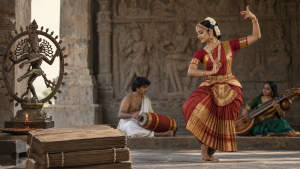
The Natya Shastra is an ancient Sanskrit treatise on drama, dance and music, traditionally attributed to Bharata Muni. Its ideas on performance, emotion and aesthetic experience have shaped Indian performing arts and remain important to the study of classical artistic traditions.
Origin, Authorship and Structure
The Natya Shastra is traditionally ascribed to the sage Bharata Muni, revered as an early teacher of the performing arts. His historical identity is uncertain. The text is generally dated to between 200 BCE and 200 CE, although a wider range, from 500 BCE to 500 CE, has also been proposed. The work contains approximately 6,000 Sanskrit verses. It is commonly organised into 36 chapters, while some versions have 37 or 38. Because of its wide-ranging and sacred character, it is often called the “fifth Veda”. It is an extensive manual of performance and theory, rather than a text confined to acting or dance.
Scope: Theatre, Music and Performance
The treatise addresses the preparation and presentation of natya—dramatic performance—from the design of the playhouse to the experience of the audience. Its subject matter includes:
- Theatre architecture: The Natya Mandapa and the sizes and shapes of playhouses.
- Dramatic construction: Vastu, or guidance on developing dramatic plots.
- Speech and poetry: Kavya and Bhasha, including principles for dramatic language and verse.
- Music: Sangita, including vocal and instrumental music, scales (gramas), modes (murchhanas) and rhythmic cycles (talas).
- Stagecraft: Costumes, make-up and other conventions suited to different regions.
It also discusses movement, gesture, performance technique and audience appreciation. Siddhi refers to success in performance, understood through audience response. Taken together, these subjects connect the practical requirements of theatre with the artistic principles that guide its creation and reception.
Rasa and Bhava
The theory of rasa and bhava is central to the text’s account of aesthetic experience. Bhava is the emotion or mental state represented by the performer; rasa is the aesthetic experience evoked in the audience. The text identifies eight permanent emotional states, or sthayi bhavas, and links their development in performance to eight rasas:
- Rati: Love; it gives rise to Shringara (erotic).
- Hasa: Mirth; it gives rise to Hasya (comic).
- Soka: Sorrow; it gives rise to Karuna (pathetic).
- Krodha: Anger; it gives rise to Raudra (furious).
- Utsaha: Heroism; it gives rise to Vira (heroic).
- Bhaya: Fear; it gives rise to Bhayanaka (terrible).
- Jugupsa: Disgust; it gives rise to Bibhatsa (odious).
- Vismaya: Wonder; it gives rise to Adbhuta (wondrous).
Later commentary, including that of Abhinavagupta, added Shanta (tranquil) as a ninth rasa. This framework distinguishes the emotion enacted on stage from the aesthetic response experienced by the audience.
Abhinaya: Modes of Expression
Abhinaya is the art of conveying character, emotion and narrative to an audience. The treatise classifies it into four modes:
- Angika: Expression through the body, including posture, movement, hand gestures (mudras) and facial expression. It can involve the head, hands, eyes, eyebrows, nose, cheeks and chin.
- Vachika: Expression through speech, including dialogue, recitation, intonation, rhythm and pronunciation, as well as poetic and linguistic features.
- Aharya: External aids such as costumes, make-up, ornaments, stage properties and set design, which help establish character, setting and mood.
- Sattvika: Involuntary physical responses associated with emotional states, such as tears, trembling, sweating, changes of voice, horripilation and stupefaction. It is often regarded as a particularly demanding form because it conveys deep emotional involvement.
Dance Categories, Karanas and Cultural Significance
The text distinguishes three broad categories of dance and performance:
- Nritta: Pure, rhythmic and abstract movement without a specific narrative or interpretive component. In Bharatanatyam, it is characterised by fast, rhythmic movement without an interpretive or narrative element.
- Nritya: Expressive dance combining movement with emotion and meaning, conveyed through gestures, facial expressions and body language.
- Natya: Dramatic representation, bringing together dialogue, music, dance and the modes of abhinaya to convey a narrative.
The Natya Shastra also describes karanas, coordinated units combining hand gestures (hasta), foot positions (pada) and body movement. It identifies 108 such units. An angahara is a sequence of six to nine karanas; the text outlines 32 angaharas. Sculptural representations of karanas are found at temples including the Chidambaram Nataraja Temple. These concepts inform the technical vocabulary of classical dance traditions, including Bharatanatyam, Odissi and Kuchipudi. In Bharatanatyam, a bani denotes a guru- or school-specific technique and style, often named after the guru’s village. Its movement technique combines a relatively fixed upper torso with bent legs and flexed knees, footwork, and gestures of the hands, eyes and face. Studying and documenting such traditions links classical knowledge systems with heritage documentation and cultural scholarship.
Key Prelims Takeaways
- Attribution and date: Traditionally attributed to Bharata Muni; commonly dated to 200 BCE–200 CE, with wider proposed dates.
- Structure: Approximately 6,000 verses; usually 36 chapters, with versions of 37 or 38.
- Aesthetics: Eight principal rasas arise from eight sthayi bhavas; Shanta was added later.
- Abhinaya: Angika (body), Vachika (speech), Aharya (external aids) and Sattvika (involuntary responses).
- Dance terms: Nritta is abstract movement, Nritya expressive dance and Natya dramatic representation.
- Movement units: The text describes 108 karanas and 32 angaharas, each formed from six to nine karanas.
Recent Context
At the 31st Sangit Kala Kendra Awards on November 15, 2026, Dr Padma Subrahmanyam received the Aditya Vikram Birla Kalashikhar Puraskar; Rajashree Birla is the organisation’s President. Dance was the emphasis. Rahul Varshney and Saurav and Gaurav Mishra received the Kala Kiran Puraskar. Subrahmanyam is known for reconstructing the 108 karanas.
| Related | |
|---|---|