NASA Unveils Three-Phase Moon Base Plan
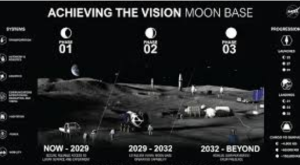
NASA announced a three-phase plan for a permanent Moon base near the lunar South Pole on 24 March 2026 and reaffirmed it on 27 May 2026. The plan carries an estimated investment of $20 billion over seven years and forms part of the Artemis programme for sustained human presence on the Moon.
Artemis Programme and Lunar Surface Strategy
The Artemis programme is NASA’s human spaceflight programme for lunar exploration and future Mars missions. The Moon base plan places emphasis on the lunar South Pole, which contains permanently shadowed regions and is a target area for robotic and crewed missions.
Phase One: Robotic Missions and Cargo Delivery
Phase one runs through 2029 and covers robotic missions, cargo delivery, and lunar surface technology testing. NASA plans up to 25 missions with 21 lunar landings in this phase, along with expanded Commercial Lunar Payload Services deliveries and the Lunar Terrain Vehicle programme. Moon Base-I is planned no earlier than autumn 2026 and will use Blue Origin’s Blue Moon Mark 1 Endurance lander. The mission will deliver equipment to the Shackleton Connecting Ridge for risk reduction before future crewed Artemis landings.
Phase Two and Phase Three: Infrastructure and Permanent Presence
Phase two runs from 2029 to 2032 and focuses on early semi-habitable infrastructure. The plan includes power grids, surface communication systems, and mobility systems for recurring astronaut operations lasting weeks or months. Phase three extends through 2036 and aims for a permanent base with long-duration human missions. NASA has stated a goal of continuous human presence on the Moon and crewed landings every six months.
Important Facts for Exams
- The Moon’s South Pole is a major target for lunar exploration because of its permanently shadowed craters and possible water ice deposits.
- Commercial Lunar Payload Services, or CLPS, is NASA’s programme for buying lunar delivery services from private companies.
- The Lunar Gateway is a planned lunar-orbiting space station linked to NASA’s Artemis architecture.
- Blue Origin and Astrobotic are among the commercial partners associated with lunar landers and surface mobility systems.
Programme Cost and Space Policy Context
The Moon base component is estimated at 20 billion over seven years. NASA’s Office of Inspector General has estimated that the broader Artemis programme cost increased to 93 billion between 2012 and 2025.
| Related | |
|---|---|