Medico-Legal Procedures in Death Investigation in India
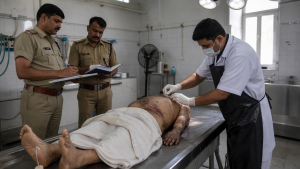
A medico-legal death investigation combines medical examination with police or magistrate inquiry to establish how and why a person died. Proper registration, documentation and preservation of evidence support criminal justice, protect procedural rights and help courts assess the evidence.
Medico-Legal Cases: Definition and Registration
A Medico-Legal Case (MLC) is an injury or ailment in which the attending doctor considers law-enforcement investigation necessary to establish the circumstances and responsibility. Clinical findings that may have legal consequences require careful assessment and documentation. Cases commonly registered as MLCs include unnatural deaths, road traffic accidents, suspected homicide, suicide, poisoning, physical assault, burns, sexual offences, criminal abortion, and deaths that are suspicious or have an unclear cause. A registered medical practitioner on duty has the authority and duty to register an MLC promptly. A patient’s or relative’s request not to register a case should not override the need to follow the applicable legal and professional requirements.
Reporting and Medical Documentation
The treating doctor should first provide necessary life-saving care, then report the MLC to the nearest police station as required by law. Standard medico-legal guidance cites Section 39 of the Criminal Procedure Code (CrPC) for reporting cognizable offences; failure to report such an offence is an offence under the Bharatiya Nyaya Sanhita (BNS). The record should be clear, complete and made contemporaneously. It should include:
- Identification and timing: Patient identity and time of arrival.
- Source of information: Informer’s details and account, recorded distinctly from the doctor’s observations.
- Clinical findings: Description of injuries, their location and relevant observations.
- Police details: Name of the police station notified or concerned.
- Authentication: Treating doctor’s dated signature and appropriately timed entries.
Accurate records help preserve the distinction between observed medical facts and information supplied by others, and provide a traceable account for subsequent investigation.
Post-Mortem Examination and Legal Basis
A post-mortem examination, or autopsy, is conducted after death to determine its cause, circumstances and manner—natural, accidental, suicidal or homicidal. It is required in cases such as unnatural, suspicious, sudden or unexplained deaths, including deaths involving accidents, suspected homicide or suicide, and custodial deaths. The traditional CrPC framework cites Sections 174 and 176 for police and magistrate inquiries into deaths and the ordering of examinations. Section 174 concerns the police inquiry and report on the apparent cause of death; Section 176 provides for a magistrate’s inquiry, including in specified cases such as custodial deaths. These references should be read in light of the current statutory framework: the Bharatiya Nagarik Suraksha Sanhita (BNSS) has replaced the CrPC. The distinction between a preliminary inquiry into the apparent cause and a medical examination to establish findings remains important.
Autopsy: Authority, Procedure and Evidence
A post-mortem is generally performed by a forensic pathologist or a trained medical officer, often in a government hospital with forensic facilities. It requires a written requisition in the prescribed form from a competent authority, such as a police officer or magistrate. The supplied guidance specifies that a police officer requesting the examination should be at least an Assistant Sub-Inspector (ASI). An extract of the inquest report, commonly called a “Panchnama,” accompanies the requisition and records the apparent cause of death and observed injuries. The examination includes:
- External examination: A systematic inspection for injuries, abnormalities and other relevant features.
- Internal examination: Dissection and assessment of organs for trauma, disease, poisoning or other factors contributing to death.
- Laboratory analysis: Collection of blood, urine or tissue samples for toxicological analysis when poisoning or drug overdose is suspected.
The medical officer communicates the findings to the investigating officer, and the forensic expert prepares a detailed report for the investigating authorities. Such findings may assist the court as expert evidence. Section 45 of the Indian Evidence Act is the traditional reference for expert opinions; that Act has since been replaced by the Bharatiya Sakshya Adhiniyam. The autopsy surgeon does not decide to waive a post-mortem in an MLC death; the decision rests with the police as the investigating agency. Family consent is not routinely required for post-mortems in unnatural or suspicious deaths. These rules enable investigation while making a documented, impartial examination central to the process.
Investigation, Safeguards and Forensic Capacity
Death investigation depends on coordination between medical officers, police and magistrates. The inquest records the apparent circumstances; the autopsy provides medical findings; and the investigating agency considers these alongside other evidence. Neither an inquest nor a post-mortem report should be treated as a substitute for the full investigation. Procedural safeguards include timely notification, a written requisition, contemporaneous medical notes, appropriate sample collection and communication of findings to investigators. These steps strengthen evidentiary reliability and accountability. Forensic capacity is also important: access to trained personnel, suitable facilities and timely toxicological analysis can affect the quality and speed of investigations. In mains answers, the issue links criminal justice with scientific evidence, institutional capacity and protection against arbitrary or incomplete inquiry.
Key Prelims Takeaways
- MLC: Injury or ailment warranting law-enforcement investigation.
- Registration: Includes unnatural, suspicious and unexplained deaths, among other specified cases.
- Autopsy: Establishes the cause, circumstances and manner of death.
- Requisition: Written request by a competent authority; an inquest extract accompanies it.
- Safeguards: Family consent is not routinely required; the autopsy surgeon cannot independently waive an MLC post-mortem.
- Current codes: BNS replaced the IPC, BNSS replaced the CrPC, and the Bharatiya Sakshya Adhiniyam replaced the Indian Evidence Act.
Recent Context
The supplied account reports that actor Nana Patekar died on 8 October 2026 following cardiac arrest and that an MLC was registered. Any post-mortem would be part of the investigation to determine the precise cause and circumstances of death.
| Related | |
|---|---|