Made-in-Bharat chips for space rockets announced
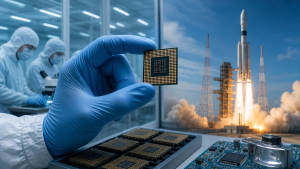
India is set to use domestically produced semiconductors in space launch vehicles after an announcement by Union Minister Ashwini Vaishnaw on 27 July 2026. The development follows a meeting with Skyroot Aerospace after the Vikram-1 Test Flight-1 reached orbit, making it India’s first privately developed orbital-class rocket.
Semiconductors in space launch vehicles
Semiconductors are electronic materials used in chips, controllers, and onboard systems in rockets and satellites. Space launch vehicles require chips that can function under vibration, radiation, temperature variation, and vacuum conditions.
Indian space chip development
In March 2026, the Indian Space Research Organisation announced a plan to produce its own semiconductors within four years. India’s space electronics work includes processors, controllers, and mission-specific hardware for launch vehicles and spacecraft.
VIKRAM3201 and related processors
At Semicon India 2025 in September 2025, India’s first fully indigenous 32-bit microprocessor, VIKRAM3201, was presented to Prime Minister Narendra Modi. The chip was developed by the Semi-conductor Laboratory and the Vikram Sarabhai Space Centre, and it was validated in space on the PSLV Orbital Experimental Module-4 in the PSLV-C60 mission. VIKRAM3201 is designed for the harsh conditions of space launch vehicles. It is a successor to the 16-bit Vikram1601, which has been used in ISRO launch vehicles since 2009.
Other indigenous space chips
In February 2025, IIT Madras and ISRO developed the Indigenous RISCV Controller for Space Applications, or IRIS, for command and control systems and other critical space functions. Another 32-bit microprocessor, KALPANA3201, was also developed for launch vehicle applications and was designed to work with open-source software toolsets.
Important Facts for Exams
- Skyroot Aerospace became India’s first privately developed orbital-class rocket company after Vikram-1 Test Flight-1 reached orbit.
- VIKRAM3201 is a 32-bit microprocessor, while Vikram1601 is a 16-bit processor used since 2009.
- PSLV-C60 carried the PSLV Orbital Experimental Module-4, where VIKRAM3201 was validated in space.
- IRIS stands for Indigenous RISCV Controller for Space Applications and is based on the SHAKTI processor baseline.
Launch vehicle electronics
Launch vehicle electronics include guidance systems, telemetry units, onboard computers, and control processors. India’s space hardware ecosystem includes ISRO, the Semi-conductor Laboratory, the Vikram Sarabhai Space Centre, IIT Madras, and private firms such as Skyroot Aerospace.
| Related | |
|---|---|