Karnataka High Court Strikes Down Parts of BMRCL Way Leave Policy
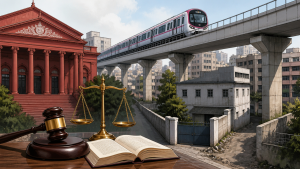
On 9 November 2026, the Karnataka High Court invalidated parts of the Bangalore Metro Rail Corporation Limited’s (BMRCL) Way Leave Policy and directed it to plan for the impact of metro-related land acquisition on access to the remaining parts of properties.
Ruling on access and charges
Justice Suraj Govindaraj partly allowed a petition by Ellis Fashion Exports Private Limited. Its Bannerghatta Road property was left landlocked after BMRCL acquired its road-facing frontage for Jayadeva Hospital Metro Station. The court ordered BMRCL to provide permanent access to the property free of charge and without a fixed-term agreement, and imposed costs of ₹10 lakh on the corporation.
The court struck down policy provisions allowing BMRCL to end a way-leave facility without notice and excluding compensation, refunds or alternative access. It also invalidated charges under clause 4 for passages wider than 3.5 metres, electricity lines and water or sewage pipelines serving landlocked properties, along with requirements for 10 years’ advance payment and charge revisions linked to prevailing guidance value. These provisions cannot apply where BMRCL’s acquisition has removed an owner’s original access or frontage.
Planning and implementation directions
Where acquisition may disrupt effective access or essential services, BMRCL must inspect the site, consult the owner and record its assessment and proposed arrangement in writing before disruption. It must coordinate with service providers on utility continuity or restoration. If replacement access is not reasonably possible, BMRCL must explain why and consider acquisition of the remaining property or another lawful solution. Its managing director must issue internal compliance instructions.
Important Facts for Exams
- Temporary character: A wayleave is normally temporary and does not automatically transfer to a new owner or occupier.
- Necessity in India: In India, an easement of necessity may be claimed only where a transfer, bequest or partition makes such a claim necessary.
- Severance in compensation assessment: Section 28 of India’s Right to Fair Compensation and Transparency in Land Acquisition Act 2013 requires consideration of damage caused by severing acquired land from other property.
- Prescriptive right of way: Under the Indian Easements Act, a right of way may be acquired by prescription after 20 years’ open, peaceable, uninterrupted enjoyment as an easement; Government land requires 30 years.
| Related | |
|---|---|