Karnataka announces mobile biodiversity museum and 17-department green-cover plan
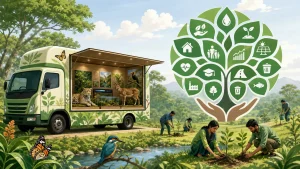
The Karnataka State Western Ghats Conservation Task Force Committee announced Western Ghats on Wheels, a mobile biodiversity museum, and Project Sahyadri Samvardhana 2026, a plan involving 17 government departments to increase green cover.
Western Ghats on Wheels is intended to take a rainforest experience to schoolchildren in all 31 districts. A 15-metre bus is to be converted into an air-conditioned, zero-carbon museum with biodiversity displays, interactive digital exhibits, maps and multilingual audio guides. The museum is expected to be ready in six to eight months.
Under Project Sahyadri Samvardhana 2026, the Forest Department plans to plant 50 lakh native saplings in one year. The Revenue Department and district administrations will identify 300–500 hectares of land. The Tourism Department plans five low-impact Western Ghats Experience Centres, beginning with a site at Jog Falls.
Notable Points
- Western Ghats: ecosystems and monsoon: The Western Ghats include dry deciduous forests on the leeward rain-shadow side and scrub forests in the foothills. High-altitude areas in the southern range have montane grasslands interspersed with shola forests. Moist air from the Arabian Sea rises over the range, bringing rain to the western side; drier air beyond the range creates a rain-shadow region toward the Deccan interior.
- Western Ghats: watershed: The Western Ghats feed perennial river systems that include the Godavari, Kaveri and Krishna. These river systems drain nearly 40% of India’s land area.
| Related | |
|---|---|