IIT Indore Study Explains Why Chalky Rice Grains Crack
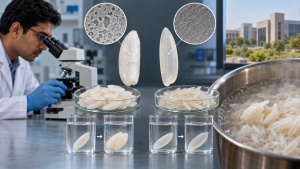
On 20 June 2026, an IIT Indore study examining why chalky rice grains burst during cooking was reported. The findings were published in the Journal of Food Science.
What the experiments found
The research was conducted by Dr Ankur Miglani, Professor Pawan Kumar Kankar, Dr Aman Khurana and PhD scholars Nitin Sapkal, Anoop KR and Sourav Kumar. In single-grain cooking experiments using Pusa 1121 basmati rice, about 67% of fully chalky grains burst, compared with 13% of healthy grains. Chalky grains contain microscopic internal cracks and air pockets, and absorb water nearly 2.7 times faster than healthy, translucent grains during soaking. Rapid, uneven water absorption and expansion create internal mechanical stress, causing the grains to crack or burst.
Important Facts for Exams
- Grain-size criterion: APEDA’s Basmati eligibility criteria include a minimum average precooked milled-grain length of 6.61 mm and an average breadth of up to 2 mm.
- DNA-based certification: The Basmati Mark uses DNA fingerprinting to certify rice, with testing carried out by the Basmati Export Development Foundation laboratory.
- Geographical indication: APEDA registered Basmati rice as a product with Geographical Indication status in India in 2016.
Category: Madhya Pradesh
Originally written on
June 20, 2026
and last modified on
November 20, 2026.
| Related | |
|---|---|